
Murder in the US Fell Dramatically in the First Half of 2026
Assessing murder at midyear.

Murder fell in the United States in the first half of 2026 pointing to a fourth straight large decline to likely a new lowest level ever recorded. This assessment is based on data from the Crime Index, Gun Violence Archive, and independently collected data from large agencies that publish such data.
Together, these data sources point to a decline that may be smaller than last year’s — which probably approached 18 or 19 percent — but would be considered record-setting in any other year in recorded history (FBI national murder estimates reliably began around 1960).
Let’s go source by source.
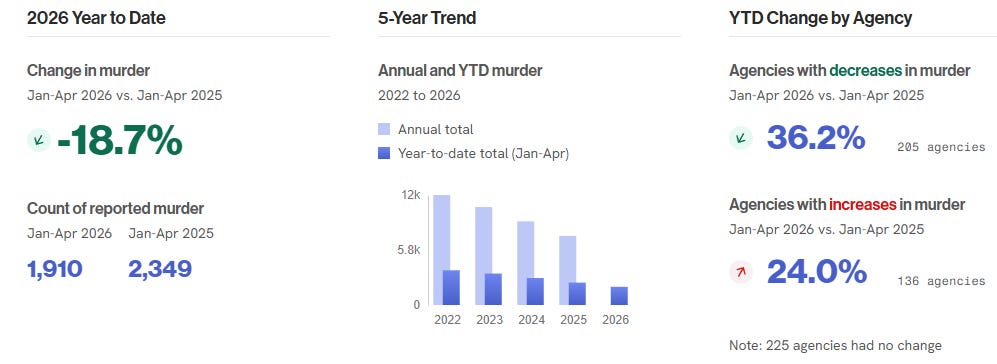
The recently renovated Crime Index has data available through April 2026 from 566 agencies covering roughly 119 million people. Murder was down 18.7 percent in those agencies through April, a strong sign that murder will fall sharply in 2026 though not a terrific barometer of just how sharply.
Still, the sample is big and the drop is big, so the Crime Index is very useful for setting an expectation that we will see a large drop in murder in 2026.
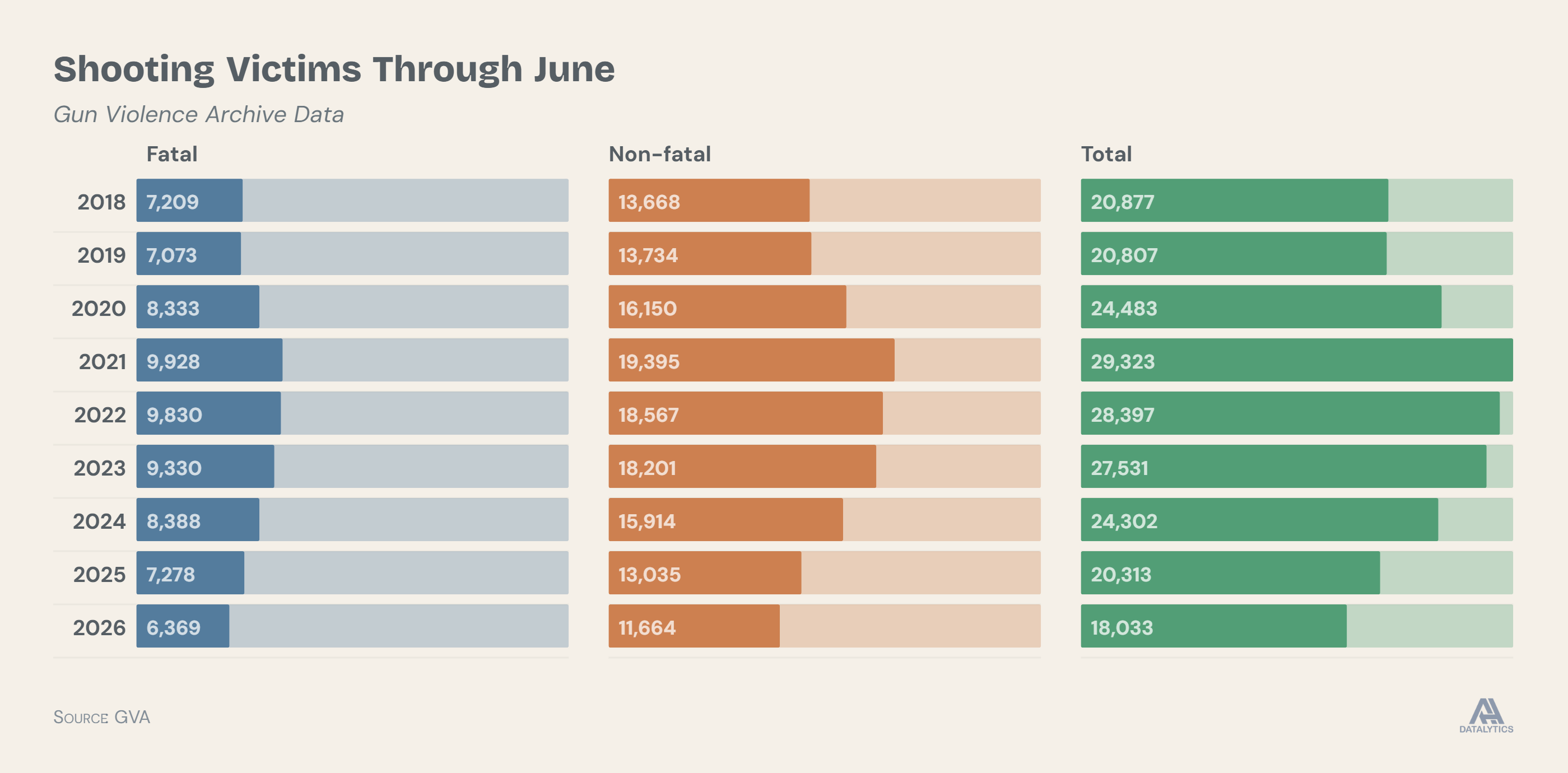
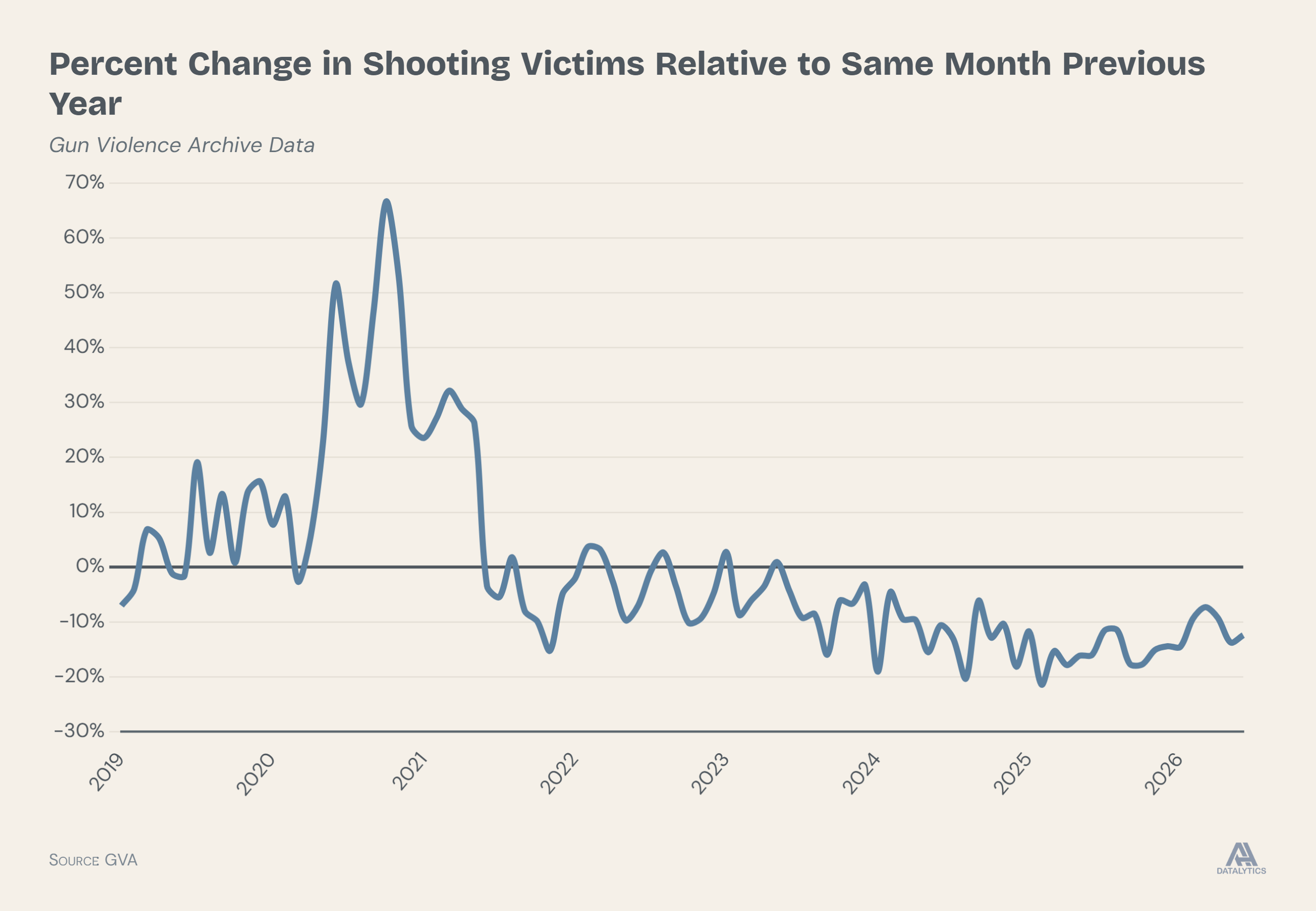
Both the Gun Violence Archive and our shooting dashboard — which grabs shooting data from 30 agencies that publish it nationwide — similarly show large drops in gun violence in 2026 which correlates very strongly with a large drop in murder this year. Shooting victims are down more than 10 percent in the Gun Violence Archive through June with the steady decline of the last few years continuing largely unchanged.
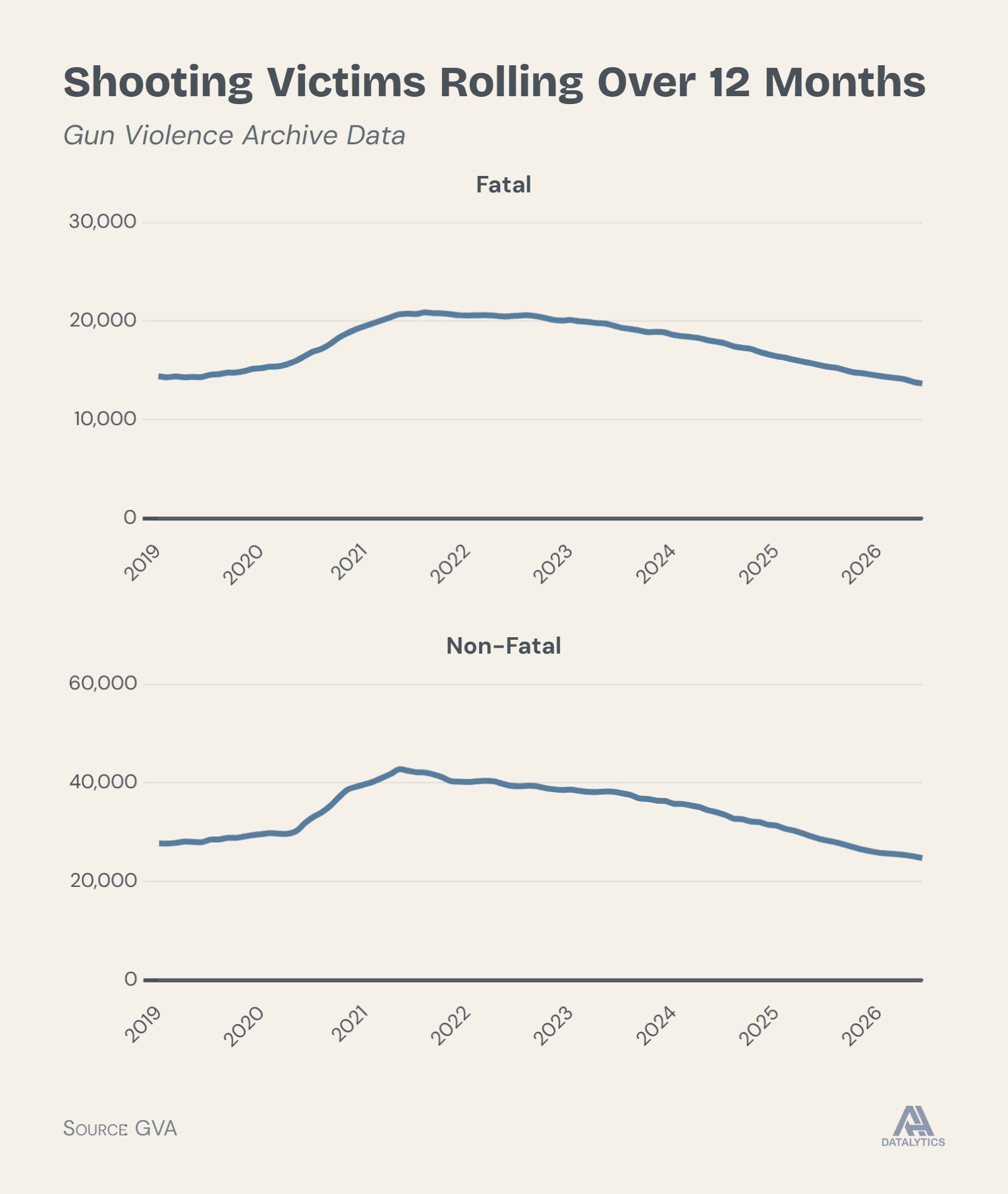
There’s maybe a bit of evidence that the pace of decline is slowing, but it is still pretty far down.
The final piece of evidence is murder in big cities with available data. I’ve been grabbing murder data from the same 30 cities all year, and this month’s sample shows the huge drop in murder continued through June (note that I’m still missing June data from the Texas agencies as of publication time).
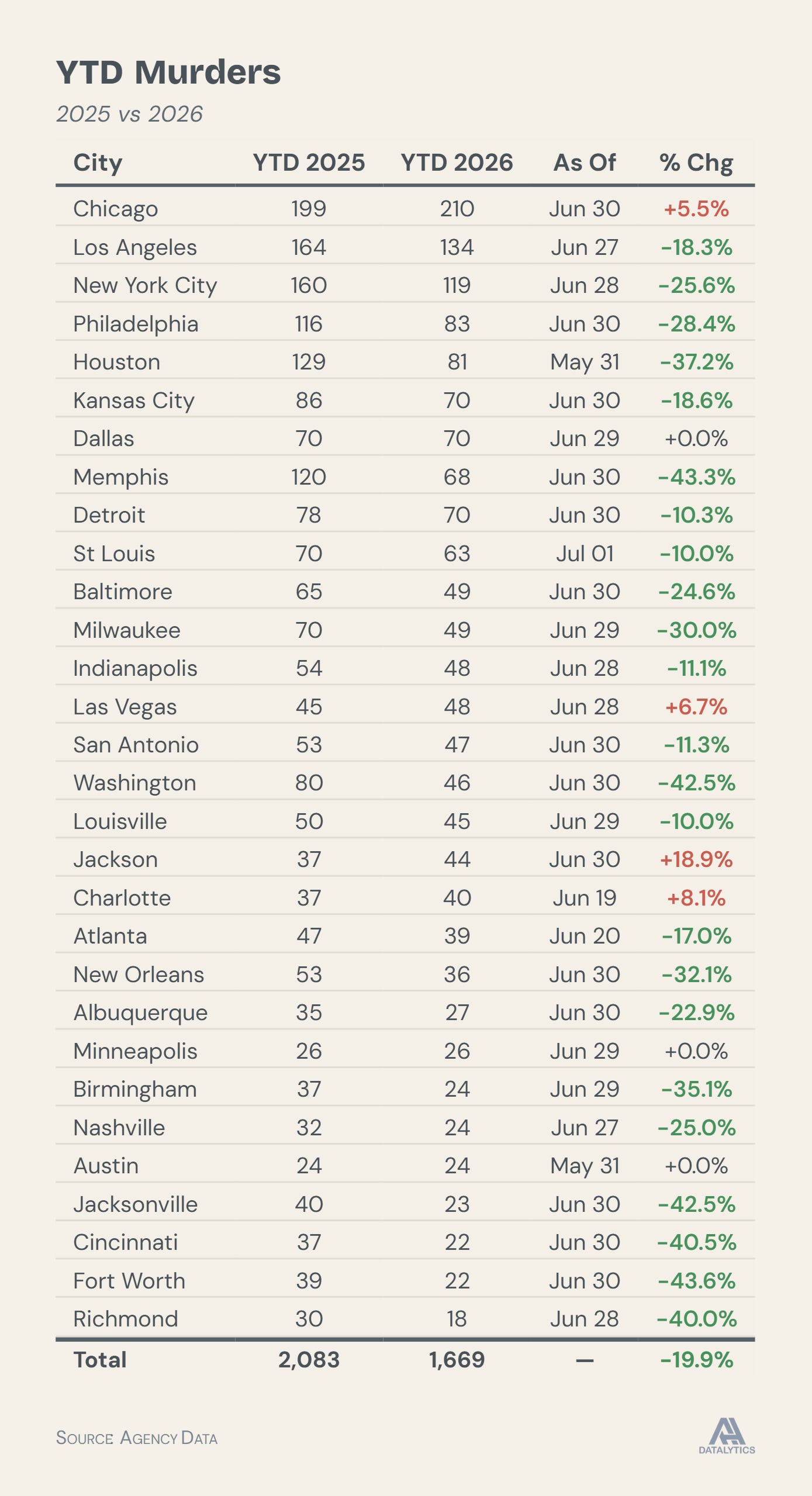
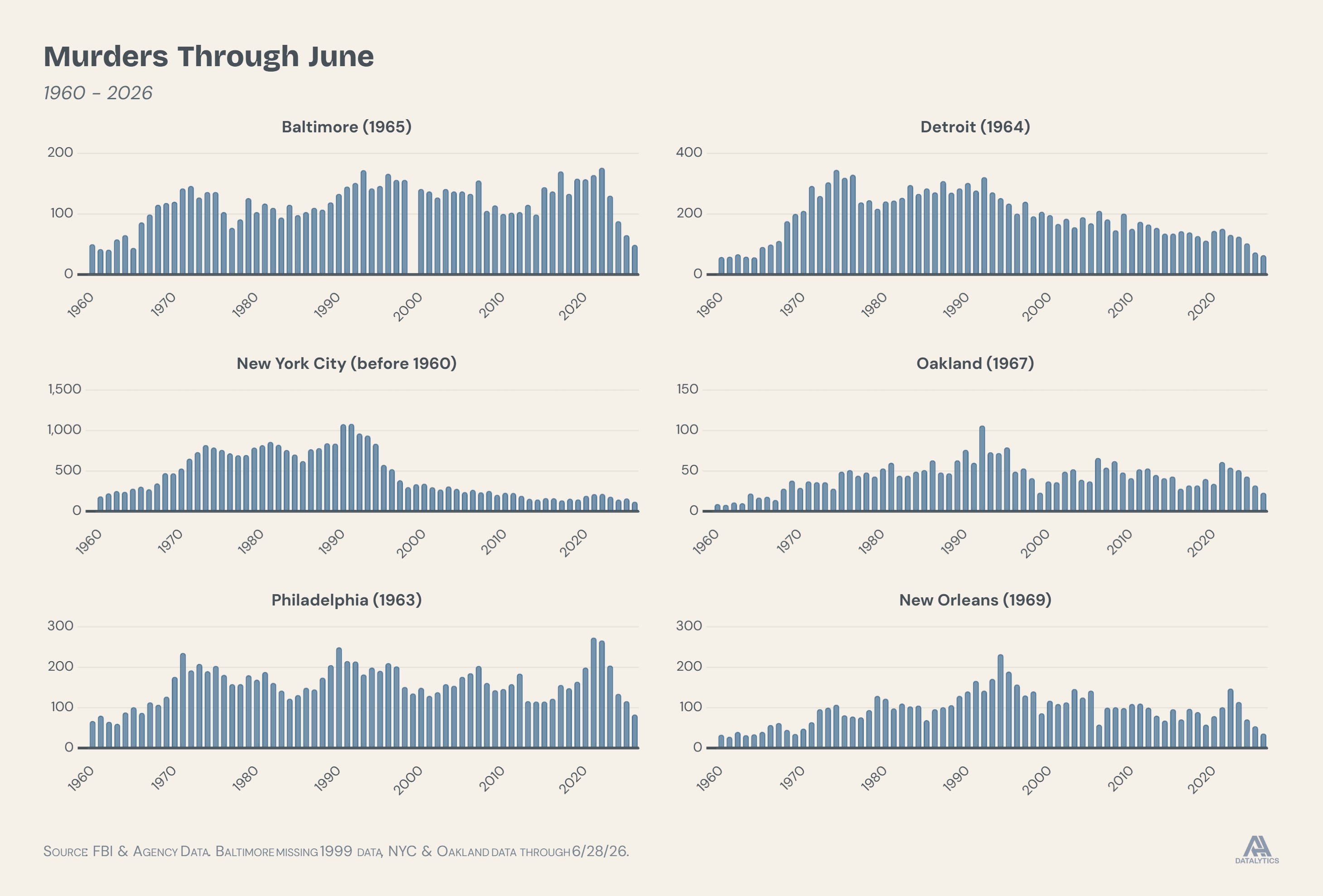
There are six cities by my preliminary exploration that are on track to have their best year since the 1960s (or before) in terms of murder with New York City on track to have its lowest number of murders ever recorded.
So, where does that leave the most likely US murder count and rate in 2026? It’s still early, but it’s not too early to make some guesses. The FBI’s first look suggested there were a bit more than 14,000 murders in the US in 2025, and the CDE shows 14,236 in 2025 right now. Both of those are likely undercounts based on how the FBI’s revision process has added around 650 murders for each year when it revises them upwards a year later.
Let’s assume that there actually were around 14,750 murders in the US in 2025 which will be reflected in the FBI’s revised 2025 totals published in the second half of 2027. That would be good for a record low of 4.3 per 100k. If we add in a guesstimated 13 percent drop in 2026 then we get a murder rate below 4 and a murder count of right around 13,000. That would be the lowest murder rate ever recorded (again) and the fewest murders in the US recorded since 1968.
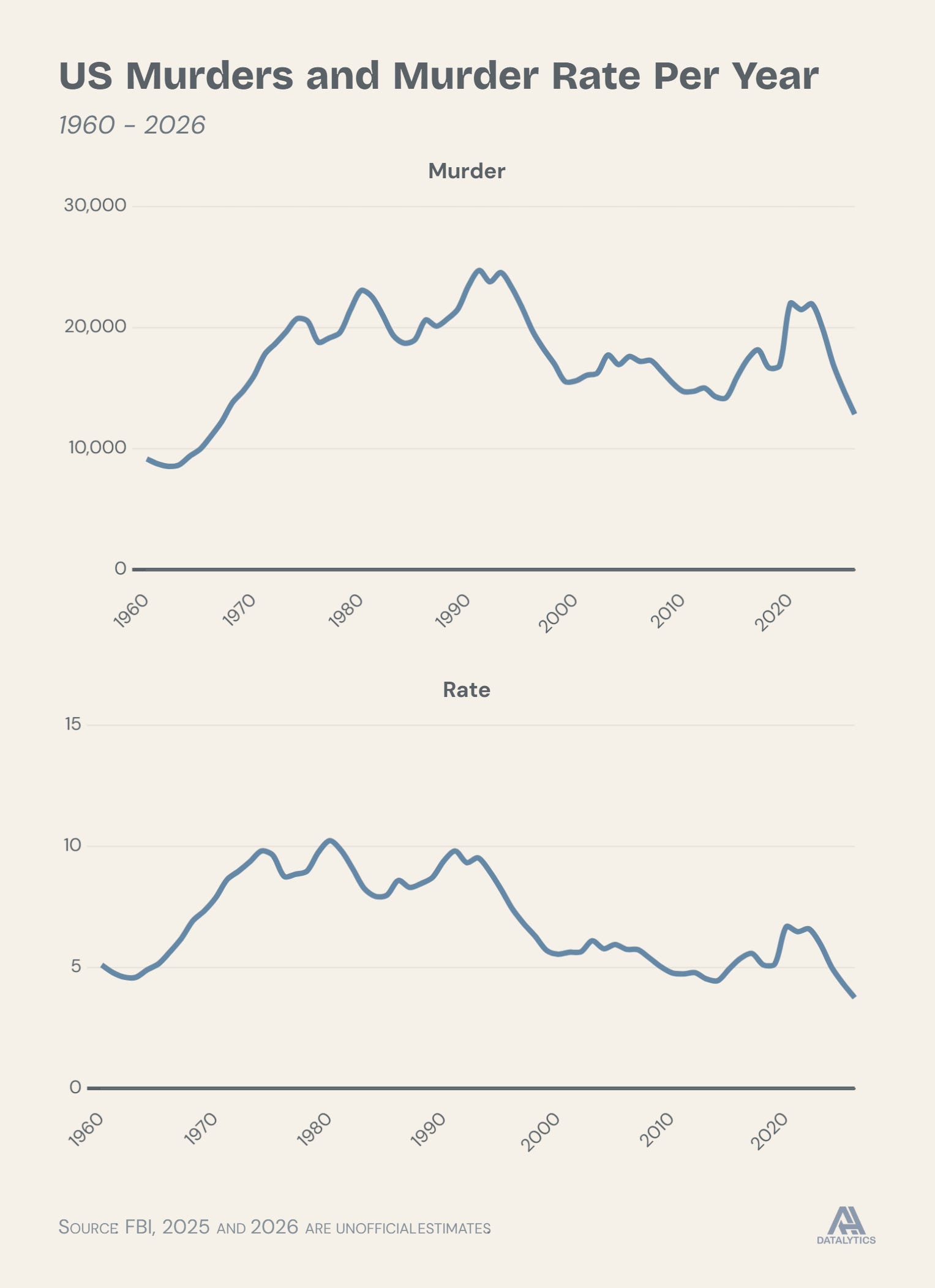
It’s too soon to say how reliable that guesstimate will be though. What we can say for sure is that murder is continuing to fall fast in 2026 and that last year’s record for lowest murder rate ever recorded will probably be broken in 2026.
One piece of housekeeping before getting to the podcast — the newsletter will be taking its first weekly break in quite some time next week. It’ll be back again on July 20th.
New on the Jeff-alytics Podcast
Christy Lopez is a professor at Georgetown Law, former DOJ Civil Rights Division attorney, and one of the leading voices on policing reform and alternative public safety responses.
In this episode, we talk about the limits of traditional police reform, why consent decrees have struggled to produce lasting change, and what it would look like to build a more diversified public safety ecosystem instead of relying almost entirely on law enforcement.
You can also catch it on the Jeff-alytics YouTube page where I’ll be posting episodes and video clips, so be sure to like and subscribe there if you’re so inclined!
And while you’re here, be sure to check out these other recent great episodes:
Yale School of Public Health Dr. Megan Ranney
Fund for a Safer Future CEO Rob Wilcox
Niskanen Center Director of Criminal Justice Greg Newburn
Center for American Progress CEO Neera Tanden
Do you have any data to back that up besides an eyeball "correlation"? Charlotte and Jackson murders are up while NYC and Baltimore murders are bottoming out. Even being as generous as possible I don't see it
There seems to be a pretty strong correlation between the strength of the positive change and the political party controlling the pertinent Statehouse. Since that factor is also highly correlated with whether the state and local law enforcement cooperates with ICE, that suggests a meaningful amount of the drop is due to ICE operations, and/or the deterrent effect thereof.