

The US had the largest one-year drop in murder ever recorded in 2025. That followed the largest one-year drop in murder ever recorded in 2024. That followed the largest one-year drop in murder ever recorded in 2023. The US probably will not have the largest one year drop in murder ever recorded in 2026, but it could very well come in second.
As a result, the United States is set to record by far the lowest murder rate ever recorded here in 2026. As I frequently note about this dichotomy, it is both far too many murders as well as an extraordinary trend that should be celebrated.
I sometimes get asked how the US murder rate compares to international peers. Comparing crime across US cities can be difficult, and comparing crime between countries can be downright impossible. Definitions differ between countries and differently trained law enforcement officers in different countries can record similar crimes differently.
Murder is more or less an exception to the challenge of comparing between countries, especially with respect to the US and Europe. So, for this piece, I set out to display just how far the US murder rate would have to fall to catch European rates.
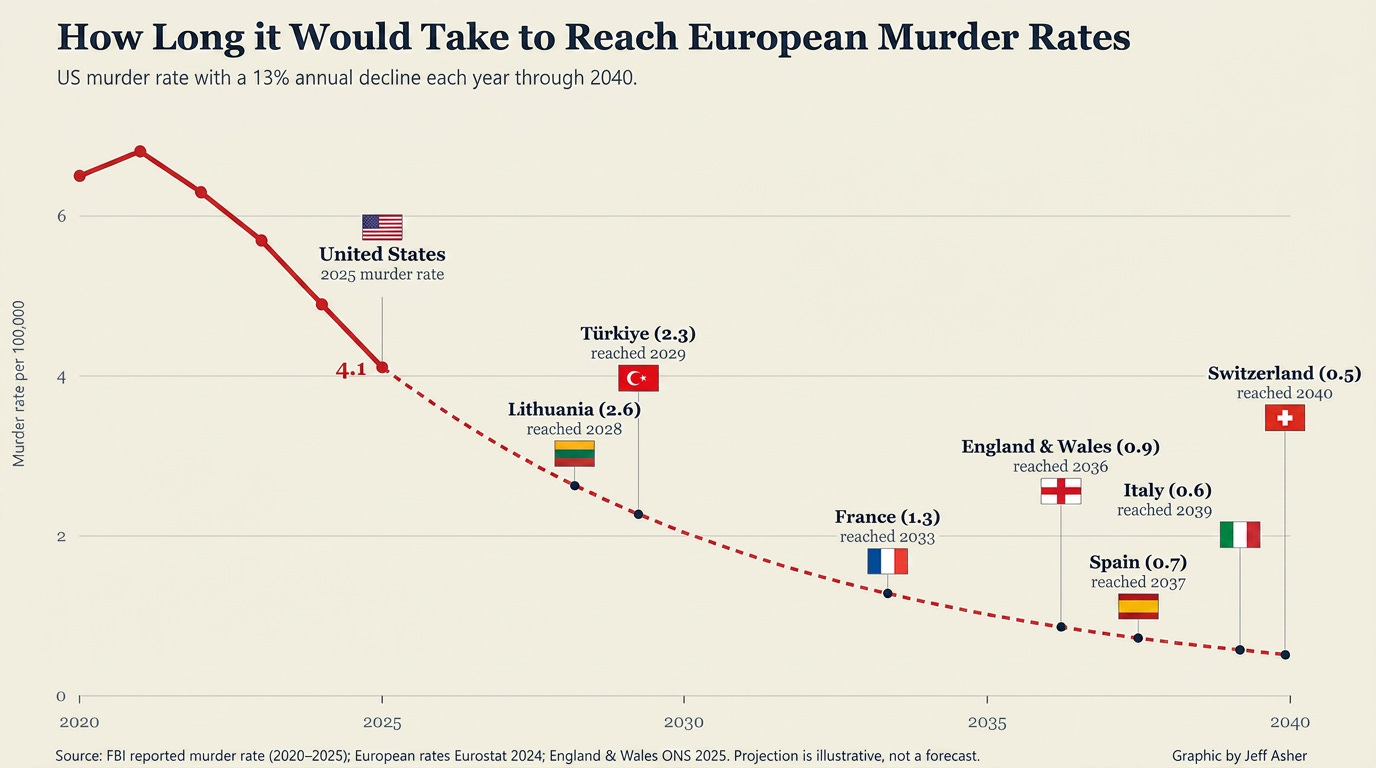
To do so, I took the US murder rate as it was estimated in 2025 and extended it out under the assumption that the murder rate falls 13 percent in every year from 2026 through 2040, which roughly matches the annual drop of 2023, 2024 and 2025. I also assume steady population growth matching the growth over the last few years over that timeframe.
This is a fantastical assumption. The largest one-year percentage drop in murder prior to 2023 was a 9 percent decline in 1996. It is a near-miracle that the US murder rate has fallen as fast as it has since 2022. The chance of it sustaining that pace for the next 15 years is more unlikely than me winning a Nobel Prize in crime data analysis newsletter writing.
But let’s take this assumption at face value and see just how long it would take the US to reach European country murder rates even under this virtually impossible to sustain pace. The answer is — a while.
In order to compare to European rates I grabbed 2024 intentional homicide data for the European Union and homicide data for England and Wales for the year ending in March 2025 (apparently the Brits left the EU). It’s not exactly 100 percent apples-to-apples to murder but it’s close enough for our purposes.
Then I charted the US murder rate extended out at the consistent 13 percent annual decline with annotations for when we’d match each European country’s homicide rate. The homicide rate in these European countries will almost certainly not stay at their 2024 levels indefinitely, but that’s beside the point.
Quick interjection per my personal AI use policy to note that Claude helped me create this graphic (ideas and data via me, graphic building help via Claude)
The US, with a sustained 13 percent drop in murder, will reach Lithuania and Türkiye’s 2024 homicide rate in just a few years. Lithuania has a population of less than 3 million and is the only country in Europe that has recorded a higher intentional homicide rate than the US murder rate since 2015. Lithuania reported intentional homicide rates of 5.75 in 2015 compared to 4.9 in the US. The country’s 2024 rate was down more than 50 percent over a decade though.
Moving on, the US would match the French murder rate of 1.3 per 100k by 2033 with just another eight years of sustained 13 percent annual decline. The US would reach England/Wales (and the overall EU average in 2024) by 2036, Spain the next year, Italy by 2039 and Switzerland’s 0.5 intentional homicides per 100k by 2040. Beyond that, it would take another three years — until 2043 — to reach Luxembourg’s EU-leading intentional homicide rate of 0.3 per 100k.
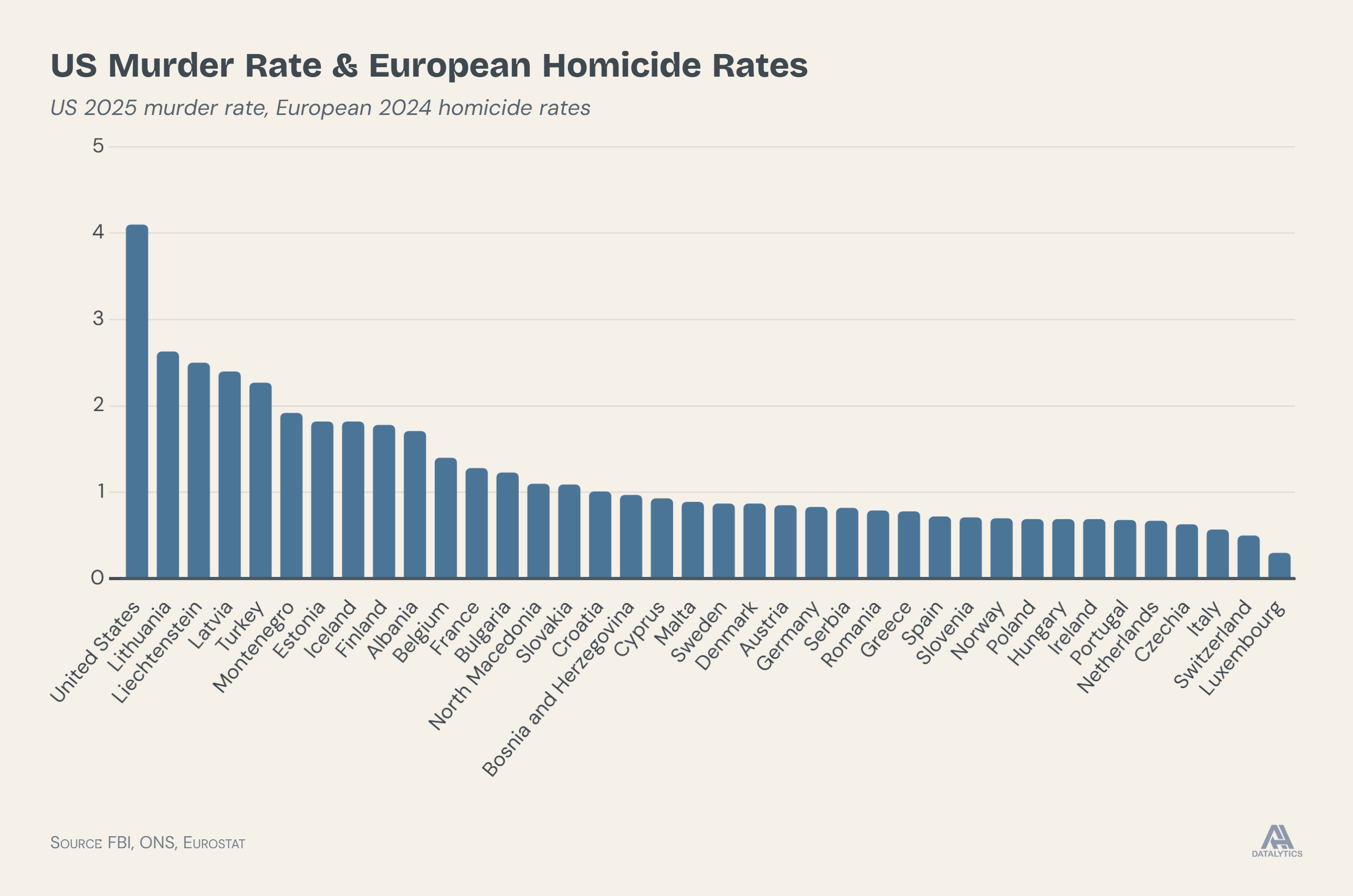
The decline in the US murder rate has been historic and the current rate is historically low, but comparing the US to our European friends points to just how much improvement can still be had in the United States.
New on the Jeff-alytic Podcast
Every crime rate, every per capita statistic, every trend line in American public safety depends on something most people have never thought about: the data infrastructure underneath it. You only notice it when it starts to break down. Today’s guest, Denice Ross, has seen this breakdown firsthand and it has informed her career ever since.
Denice has served as the Chief Data Scientist of the United States under the Biden Administration, built the Police Data Initiative – an open data effort for police departments to voluntarily publish data – under the Obama Administration, and now runs the Data Policy Institute at the Federation of American Scientists.
In this conversation, we get into what data has actually changed under the current administration. We also talk about the Census as the denominator for everything, declining survey response rates, and how Denice got a group of police chiefs to open up their records over cupcakes at the White House.
You can also catch it on the Jeff-alytics YouTube page where I’ll be posting episodes and video clips, so be sure to like and subscribe there if you’re so inclined!
And while you’re here, be sure to check out these other recent great episodes:
Michigan Economist Mike Mueller-Smith
Former ATF COO Thomas Chittum
Northwestern sociologist Andrew Papachristos
Vera President Insha Rahman
Seems more likely the other countries rates will rise to meet us, than the other way around.
"The chance of it sustaining that pace for the next 15 years is more unlikely than me winning a Nobel Prize in crime data analysis newsletter writing."
If it does, you should win that prize, though!