
What's Causing Higher Reported Rape Totals in New York City?

New York City mayor Zohran Mamdani made some news recently when he said in an interview with a local news station that rape is up in New York City due to an expanded definition of rape being applied by NYPD and more survivors coming forward. Mamdani said:
Mamdani said "And what I think is important to know is a lot of the increase in rape also comes from an expanded definition of what counts as rape, as well as survivors coming forward for acts that took place years prior."
This relatively minor comment in a local television interview led to level-headed responses from media outlets that don’t want to turn every comment from the new New York City mayor into a national news story. I am, of course, kidding.
Mayor Mamdani’s comments do raise a number of questions about NYC’s crime data that this newsletter is well situated to answer. He says that reported rape is rising, it’s rising because of a new law/definition of the crime, and it’s also rising because more victims are coming forward. All of those are testable to a degree using open data, so let’s dive in!
First, is reported rape in New York City actually up this year? Yes, rape is up 6.6 percent YTD in 2026 as of July 12 relative to the same time in 2025 per NYPD. That’s pretty minimal for any crime as far as YTD changes go, especially in July which is well before we should consider using YTD to say anything definitively about a city’s crime trends.
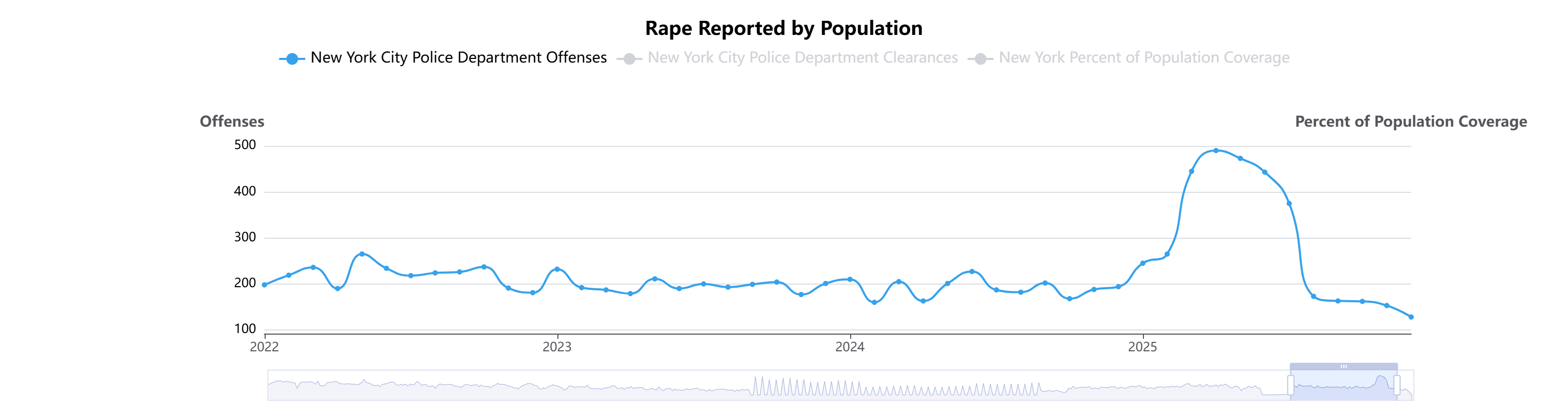
The 2026 data doesn’t really tell the whole story though. Reported rapes increased by 16 percent in 2025 per NYPD’s announcement in January which largely matches the complaint data. Other sources differ which makes the change a bit more confusing. The FBI’s Crime Data Explorer shows a 54 percent increase in rape in 2025 which probably reflects misreported data to the FBI rather than some unaccounted for huge surge in offenses. Reported rape via the CDE surged in the first six months of 2025 in an implausible way that isn’t represented in any other data sources suggesting some weirdness in how the NYPD reported data to the FBI then.
Then there’s the New York State Division of Criminal Justice Services data which actually shows a slight drop in rape in 2025 in New York City. Comparing the three highlights the absurdity of evaluating New York City crime trends.
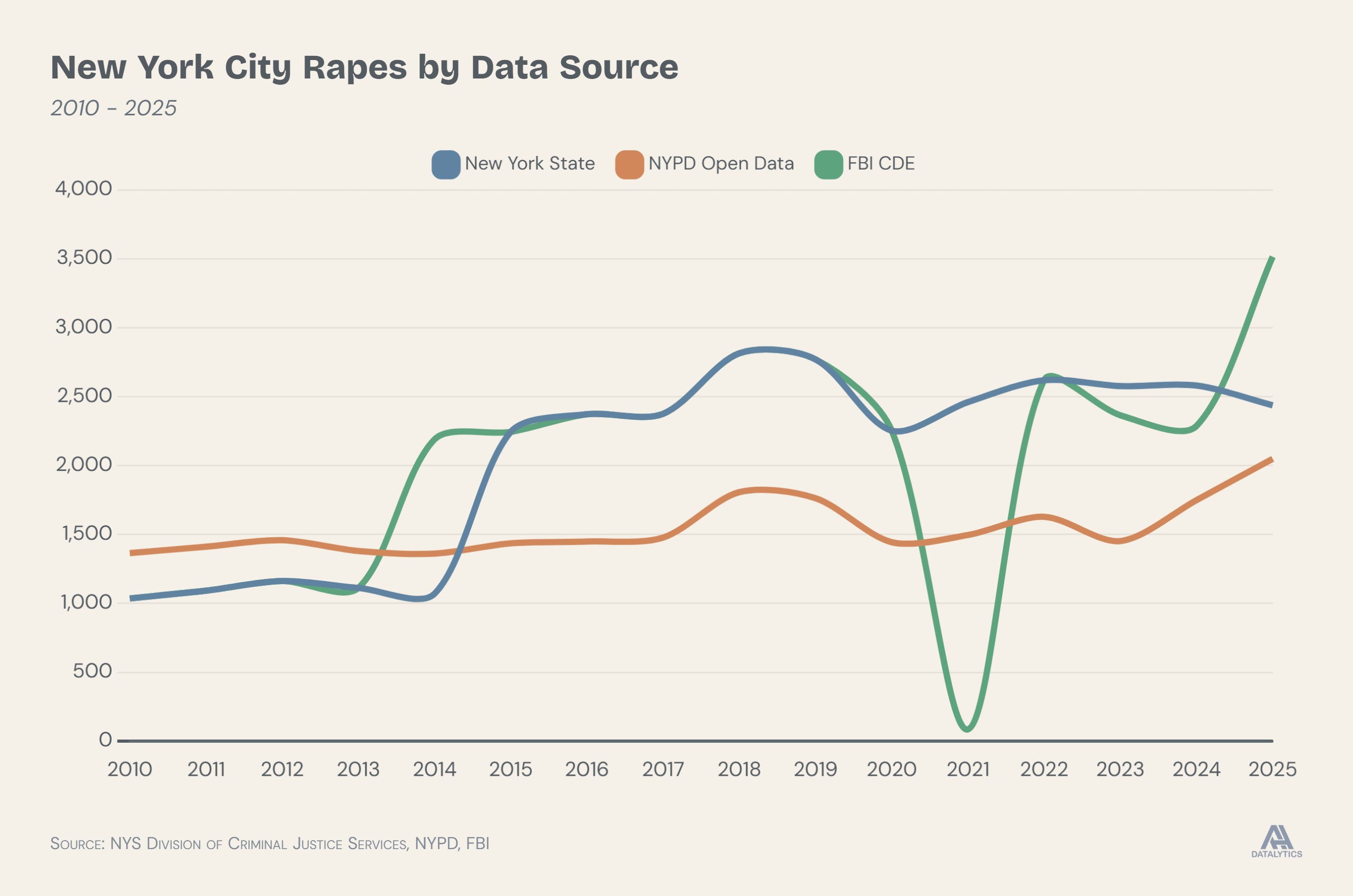
The NYPD complaint data showing a slight increase is the source I tend to trust the most, but the lack of consistent agreement amongst what should be three very similar sources is obviously problematic. And that’s even before we get into the fact that rape and sexual assaults are systemically underreported to police (less than 1/4 of victims reported to police in 2024 per NCVS), so a 6 percent increase in reported rape is better thought of as roughly even rather than an increase.
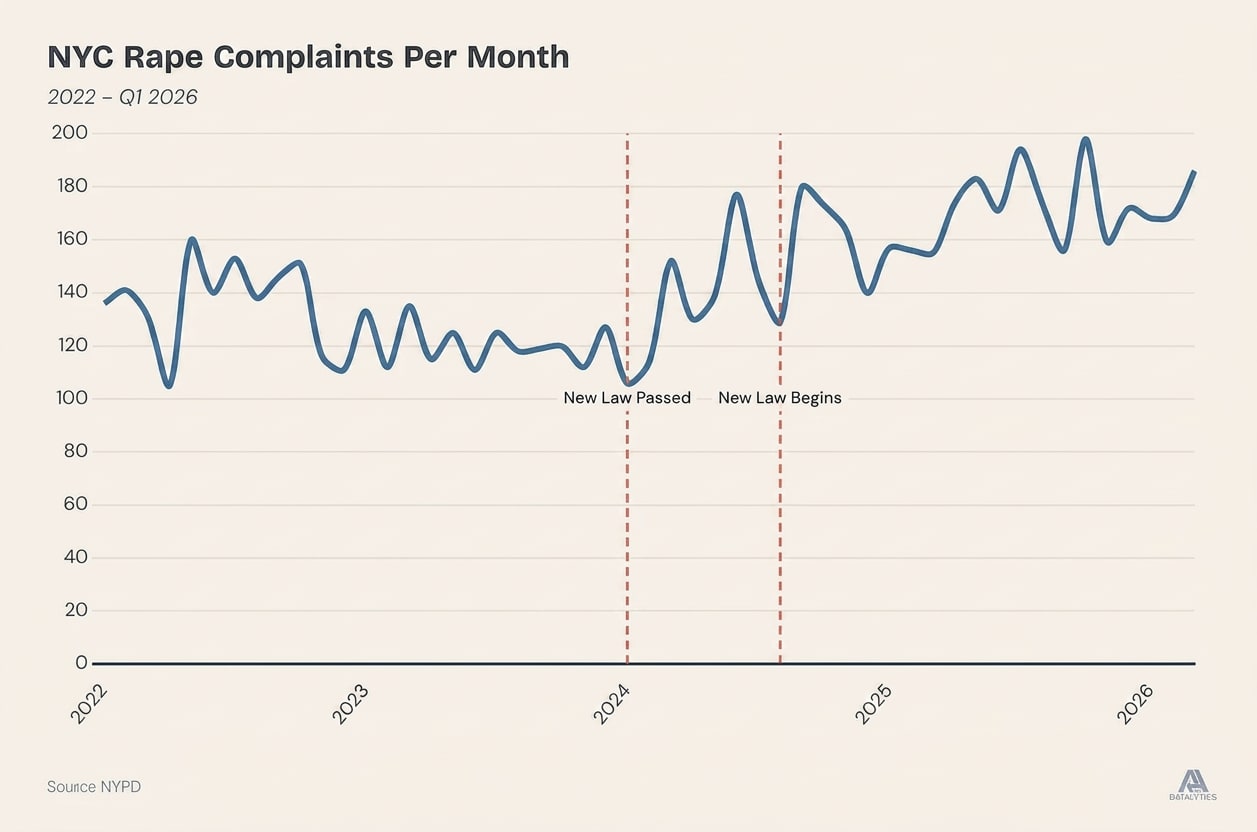
Which brings us to the second question: Did New York change how rape gets counted? This one is a clear yes. New York (the state) passed a bill in January 2024 that went into effect in September 2024 that expanded the definition of rape. This seemingly matches what the FBI did to change the definition of rape in the Uniform Crime Report Summary Reporting System in 2013 which led to a huge increase in rapes being reported by law enforcement nationwide.
In fact, if you look at the above graph you can see the impact of the FBI changing the definition of rape in 2013/2014 on reported rape counts in New York City. This adds plausibility to the idea that increased rapes in New York City in 2025 and 2026 reflects the revised statewide definition contributing to the increase.
The number of rape incidents reported in NYPD’s complaint data rose after the law came into being and seems to be related. Just how many of these extra reported rapes are because of the new way crimes are being counted is hard to say from complaint data, but it’s not unreasonable to assert that the changed definition is leading to more rapes being reported.
Third, are more survivors coming forward? This one is harder to answer for certain from the available data. As noted above, survey data shows that the vast majority of rapes and sexual assaults go unreported to police, so a change in trust/reporting patterns absolutely makes sense as a possible explanation of a rise in reported rapes in general.
There are some ways to try to answer this question in the NYPD open data. Complaint data provides the date of report and the date the complaint occurred which, in theory, would show a trend if more victims of offenses from years earlier are coming forward. If my house is broken into in January but I only report it to police in August then it should show that several month gap in the complaint data, and if more people come forward who didn't initially report then that should show up in the data.
The available data, however, doesn’t seem to show older rapes being reported more frequently than before. In fact it kind of suggests the opposite.
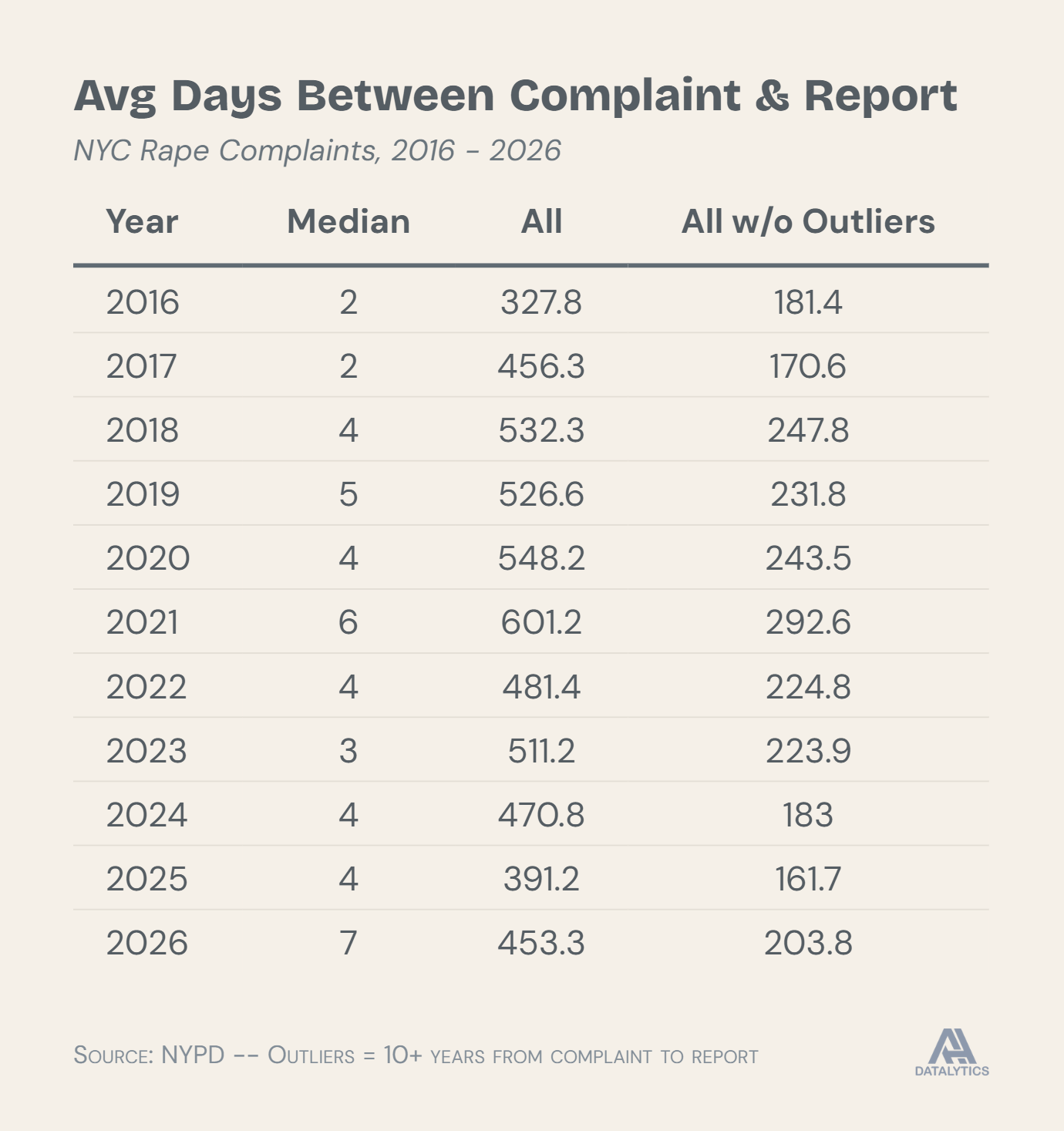
The average length of time between a complaint occurring and it being reported to NYPD fell in 2025, and the median stayed right around 4 days. We only have one quarter of data for 2026 in NYPD’s open data, but the 2026 data seems largely in line with recent years in terms of length of time from complaint to report. You could argue that the median and average times in 2026 are higher than 2025, but it’s only 3 months of data and they are not remarkably different.
The share of rape complaints where the report lagged by a year or more fell from 16 percent in 2024 to 13 percent in 2025. That share stayed largely unchanged in Q1 2026 too.
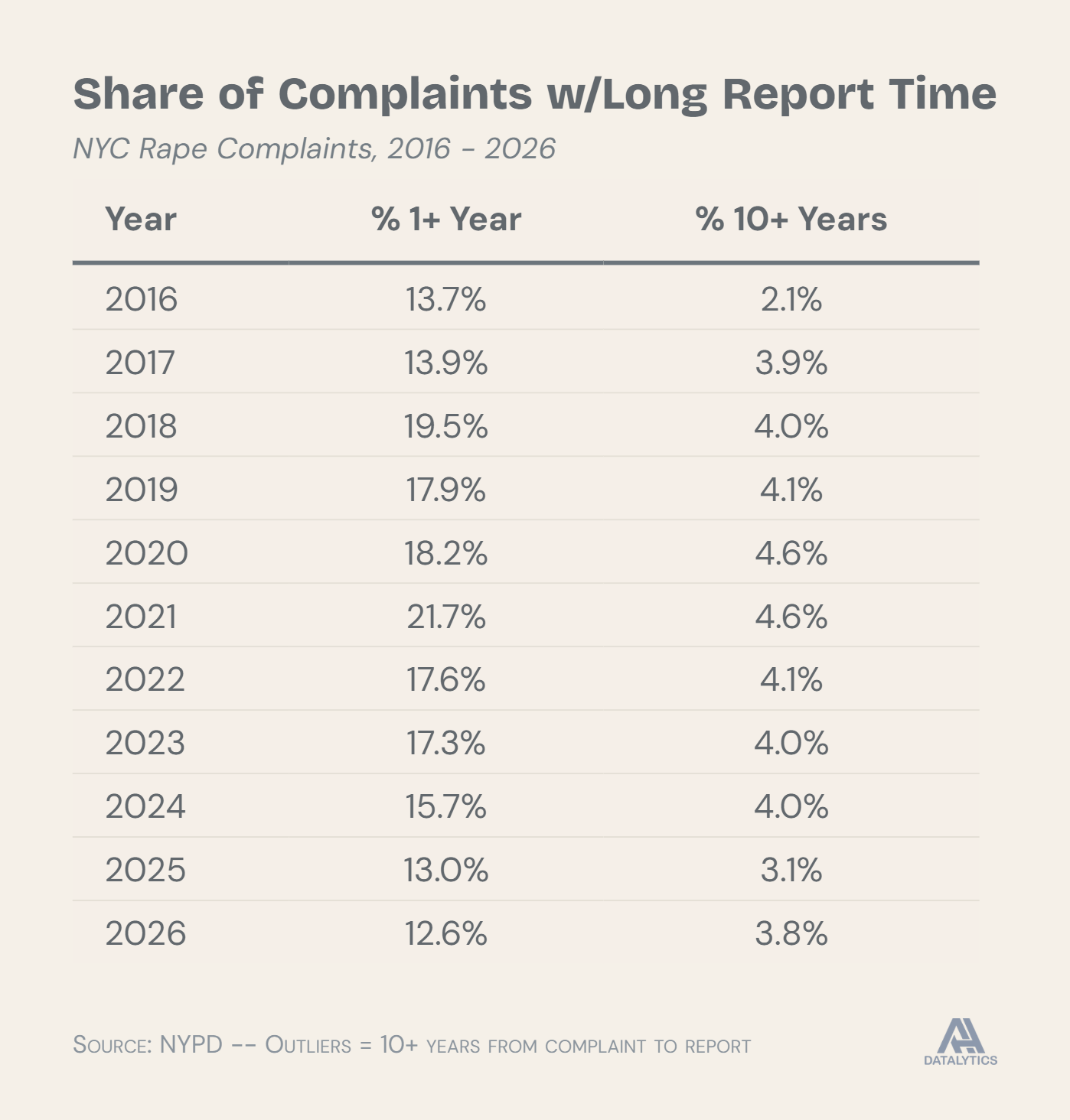
Complaint data is pretty limited in what it tells us about victim report and the metadata of the complaints don’t expose the full details of each offense. I’m cautious, therefore, to read too much into it as a definitive answer to this question without a more thorough understanding of what older offenses are being reported and when. It’s possible that a change in reporting practices is leading to more offenses being reported, but it’s less clear in the available data in my opinion.
So what can we conclude about New York City’s rape statistics?
To begin with, this review drives home just how difficult rape and sexual assault data can be to accurately track. It is virtually impossible to say whether an increase in reported rapes in New York City is due to more crimes occurring, a change in reporting by the agency, a change in reporting by victims, or all three.
In fact, not every source is even in agreement as to whether there has been an increase in reported rape in New York City at all! The city doesn’t agree with the state and none of them agree with the FBI. I tend to trust NYPD’s data the most because we can get closest to the raw data through their complaints, but even offense-level data can have errors or be unreliable (see DC’s data).
Like DC, New York City would benefit from publishing to national FBI standards of offenses rather than city or state law. Frustratingly, NYPD publishes about felony assault and grand larceny rather than aggravated assault and theft. Trends for these offenses tend to mirror the FBI UCR Part I standards, but they aren’t always identical. This problem wouldn’t be an issue if NYPD was calculating UCR Part I offenses (or NIBRS now that they’ve transitioned) since those definitions haven’t changed.
The available data does make it seem very plausible that NYPD’s increased reported rapes since the end of 2024 is related to the new state law. I wouldn't state it with complete confidence, but the mayor's assertion of what's behind increased reported rapes is more or less in line with the city's data.
The evidence is not overwhelmingly strong though and a more firm assessment is not really possible from the publicly available data.
New on the Jeff-alytics Podcast
This week’s guest has spent thirty years inside the question of America’s changing crime trends, first as a researcher at the Urban Institute, now as director of the Center on Public Safety at NORC.
In this episode, we talk about why the usual explanations for crime trends – more cops, more task forces, more local initiatives, don’t hold up against the data. We get into the role police legitimacy potentially played after George Floyd, why the decline has lasted so long, and what the future might look like.
John K. Roman, Ph.D. is a senior fellow in the Economics, Justice, and Society Department and directs the Center for Public Safety and Justice at NORC at the University of Chicago. His research focuses on the economics of innovative crime and justice policies and programs, cost-benefit methodology, and systems reforms, including justice system interactions with substance abuse, public health, adolescent development, housing, workforce development, and education. Dr. Roman has conducted research on behalf of numerous state and local governments, foundations, and federal agencies.
You can also catch it on the Jeff-alytics YouTube page where I’ll be posting episodes and video clips, so be sure to like and subscribe there if you’re so inclined!
And while you’re here, be sure to check out these other recent great episodes:
Criminologist Andy Wheeler
Filmmaker Lynn Novick
Georgetown Professor Christy Lopez
Yale School of Public Health Dr. Megan Ranney
Are prison rapes properly reflected in the stats?