

I’m frequently asked how city X compares to the worst, most dangerous place in America. Usually I resist answering that question because there’s a danger in ranking places — a danger that the FBI has frequently pointed out when releasing updated crime data.
Here’s the FBI a few years ago:
“Caution Against Ranking—Each year when Crime in the United States is published, some entities use the figures to compile rankings of cities and counties. These rough rankings provide no insight into the numerous variables that mold crime in a particular town, city, county, state, tribal area, or region. Consequently, they lead to simplistic and/or incomplete analyses that often create misleading perceptions adversely affecting communities and their residents. Valid assessments are possible only with careful study and analysis of the range of unique conditions affecting each local law enforcement jurisdiction. The data user is, therefore, cautioned against comparing crime data of individual reporting units from cities, metropolitan areas, states, or colleges or universities solely on the basis of their population coverage or student enrollment.”
But, sometimes you just want to throw caution to the wind and rank agencies to find out which is the most dangerous in the United States. So that’s what I’ve done this week.
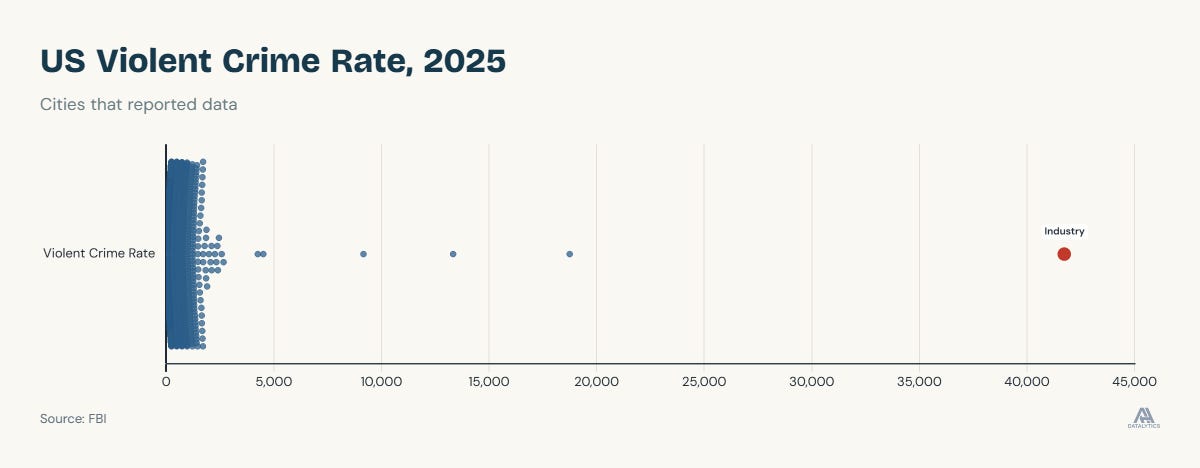
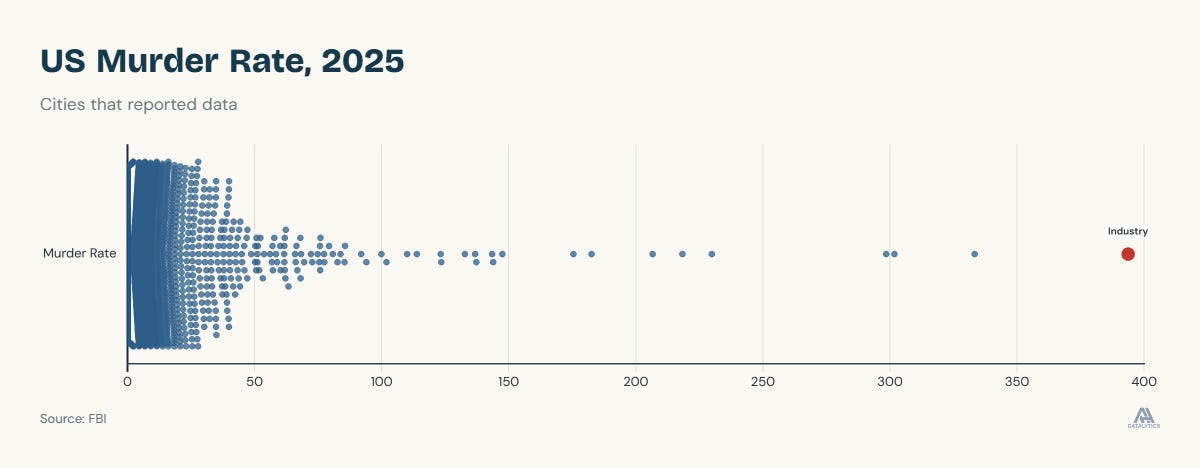
And the answer, my friends, may surprise you. The crime capital of America in 2025 comes in with a murder rate nearly 100 times the national average and a violent crime rate of nearly 130 times the national average.
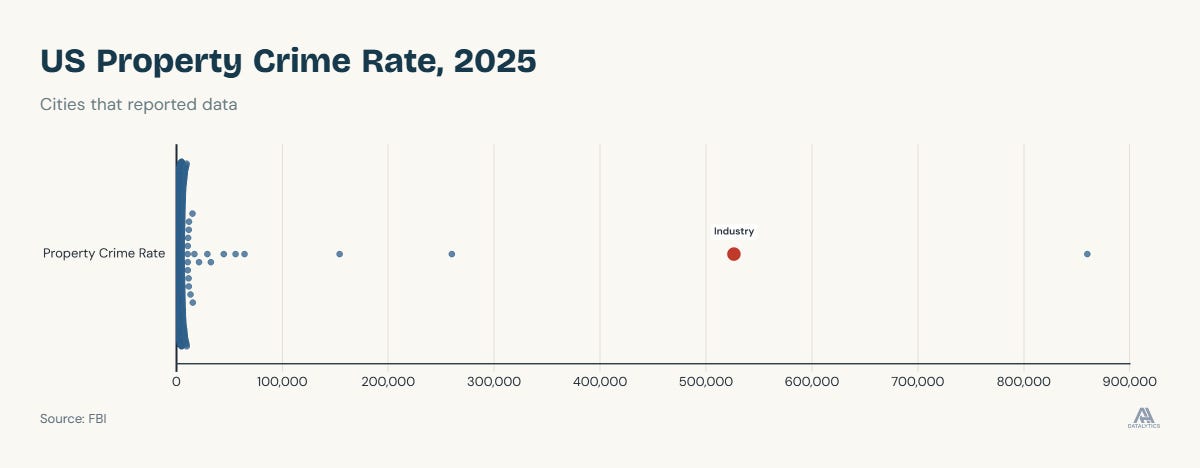
This city doesn’t have the nation’s highest property crime rate, but it is in second place with a property crime rate that is nearly 350 times the national average. If you drive your car you might as well kiss it goodbye given that this city’s rate of auto theft is more than 500 times the national average.
Just where is the center of crime and danger in America?
It’s a city in California called Industry, CA.
Industry reported a murder rate of 394 per 100k in 2025 which was down massively from the 1,5745 per 100k that the city reported in 2024. There were 41,732 violent crimes per 100k in 2025 in Industry and 526,378 property crimes per 100k. Industry really stands out on this graph of violent crime rates for every city that reported full data to the FBI in 2025.
And here’s Industry’s murder rate compared to other cities.
The city’s property crime rate is actually the second highest with Lakeside, Colorado actually having a much higher property crime rate.
This entire exercise is, of course, nonsense.
Industry is a tiny incorporated city with around 250 residents. Industry was the 10th smallest city of nearly 8,000 that reported complete data to the FBI in 2025. Industry is located within the Los Angeles metro area and contains over 3,000 businesses employing around 67,000 people if Wikipedia is to be believed.
Industry had 1 murder and 106 overall violent crimes reported to the FBI in 2025. As an aside, Lakeside, Colorado — the city with the highest property crime rate in the nation — is a “city” of 15 people just west of Denver.
All of this makes Industry the perfect talking point for how per capita crime rates can be abused — either intentionally or on accident. This city with a tiny number of official residents swells enormously each day and with employees eventually comes a bit of crime.
It’s a good lesson in why rate comparisons between cities need to be taken with a grain of salt sometimes, and it’s a great reminder of why you should ignore any best/worst/safest/most dangerous lists. Consider the below table of 2025 murder rates for the 15 cities with the highest murder rates that also reported data to the FBI (hence no New Orleans or Jackson or Baton Rouge, etc). Next, I took the share of each city’s metro area that encompasses just the city.
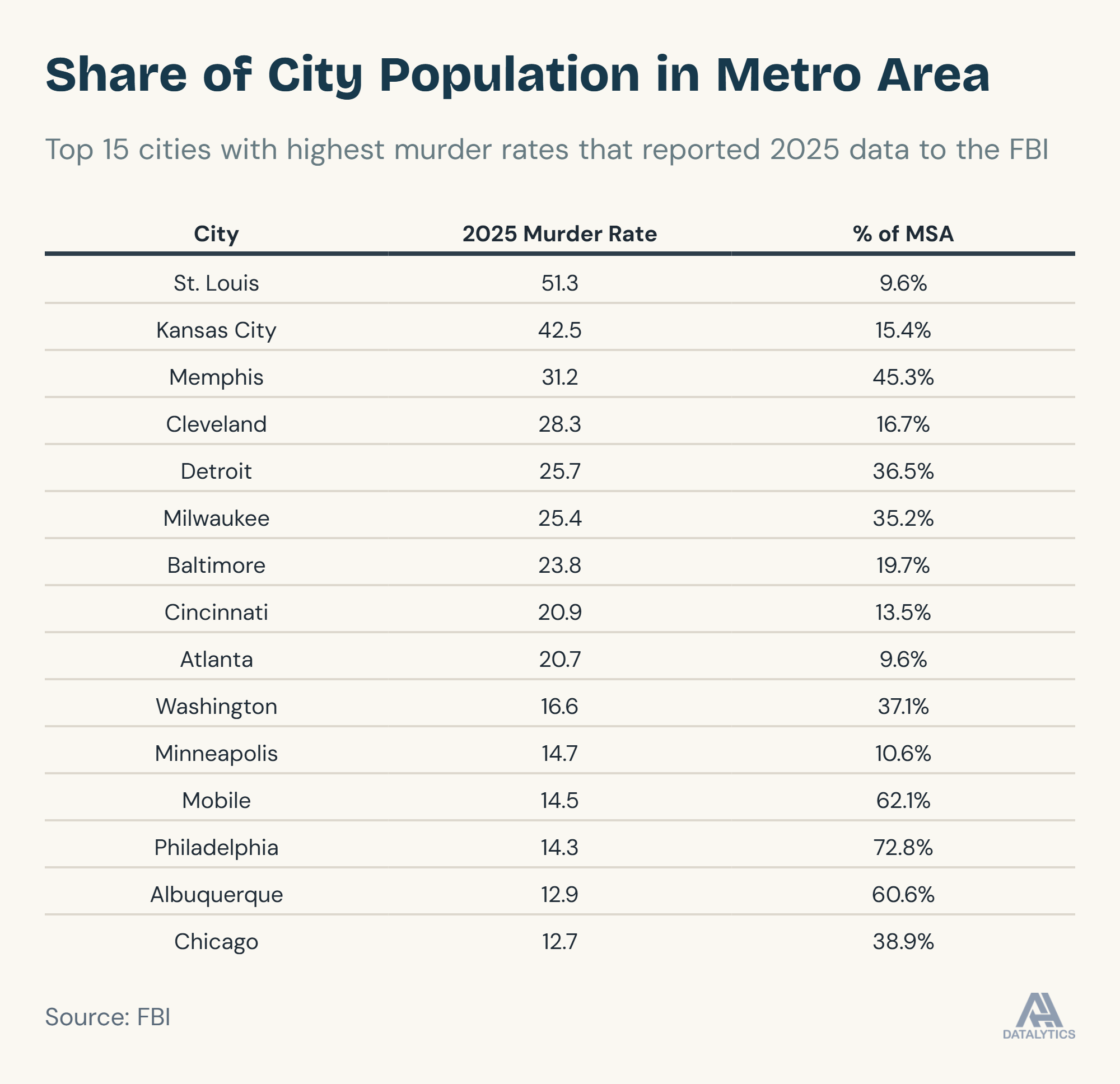
As you can see, how city borders are drawn has a huge impact on how we think of a city like St Louis — where less than 10 percent of the local metro area makes up the actual city.
You also have to consider areas that swell/shrink in crime at given times relative to the number of full time residents. Tourist areas like the French Quarter in New Orleans can draw many, many times their population yet any per capita calculation will go by the much smaller number of residents.
There can be great value in measuring crime rates. Hopefully Industry can serve as a reminder, however, that not all cities are created equal in terms of what constitutes the city boundaries. With great crime rates comes great responsibility to use them appropriately.
New on the Jeff-alytics Podcast
Mo McGough is a former DOJ attorney and self-described cop’s kid who has spent her career trying to improve how police operate. Mo helped build an NIJ program called Law Enforcement Advancing Data and Science (LEADS), which identifies and develops law enforcement officers committed to evidence-based practice. She also co-founded 30 by 30, a national movement to improve the representation and experiences of women in policing, which is now active in over 400 agencies across the country.
In this episode, we get into what it actually takes to move a profession that’s slow to change and the enormous untapped opportunity in better understanding how police departments hire and promote.
Few people that I’ve talked to have moved policing along as a profession more than Mo and her insights into what the future of policing might look like are invaluable.
You can also catch it on the Jeff-alytics YouTube page where I’ll be posting episodes and video clips, so be sure to like and subscribe there if you’re so inclined!
And while you’re here, be sure to check out these other recent great episodes:
Former DOJ Assistant Attorney General Kenneth Polite
Former Minneapolis Police Chief Brian O’Hara
Michigan Economist Mike Mueller-Smith
Former ATF COO Thomas Chittum
That was terrific. While the ideas (like percent of MSA) are sort-of self evident, nobody ever says them and I've never seen the data behind this argument. This is a great contribution to the overall debate.
Ok impressed Jeff