

The Who played the Super Bowl XLIV halftime show in February 2010. Right after that, Thomas Morstead’s made an onside kick that my Saints recovered on route to a 31-17 win for the ages.
But I digress, far earlier in the post than normal.
Nearly a half-century before that, The Who released their song The Kids Are Alright in 1965. And now, more than 60 years after that song came out, I’m using that it as inspiration for this post. Because when I need to dramatically oversimplify one explanation for why murder is continuing to fall right now I think of the phrase “the kids are alright.”
The “why is murder falling?” question is one of the most important of our times if you care about evidence-informed murder reduction policy. If we can’t understand why murder is falling now then we can’t build evidence-informed policy to continue those gains. Conveniently for this post, the Council on Criminal Justice held a recent convening (which I was unable to attend, unfortunately) that smartly sums up a number of the ideas I tend to think make sense as explainers of why murder is falling.
But there’s another point that I’ve had a hard time articulating because it’s much harder to nail down. One thing you see when analyzing murder victim data is that it’s falling in America among every age cohort. Yet it is falling most historically among young adults, and the explanation for why murder in America is falling to historical lows — rather than just a return to the pre-COVID norm — is almost certainly happening there.
See this chart of young adult murder victims and murder victims from all other age ranges per year this century:
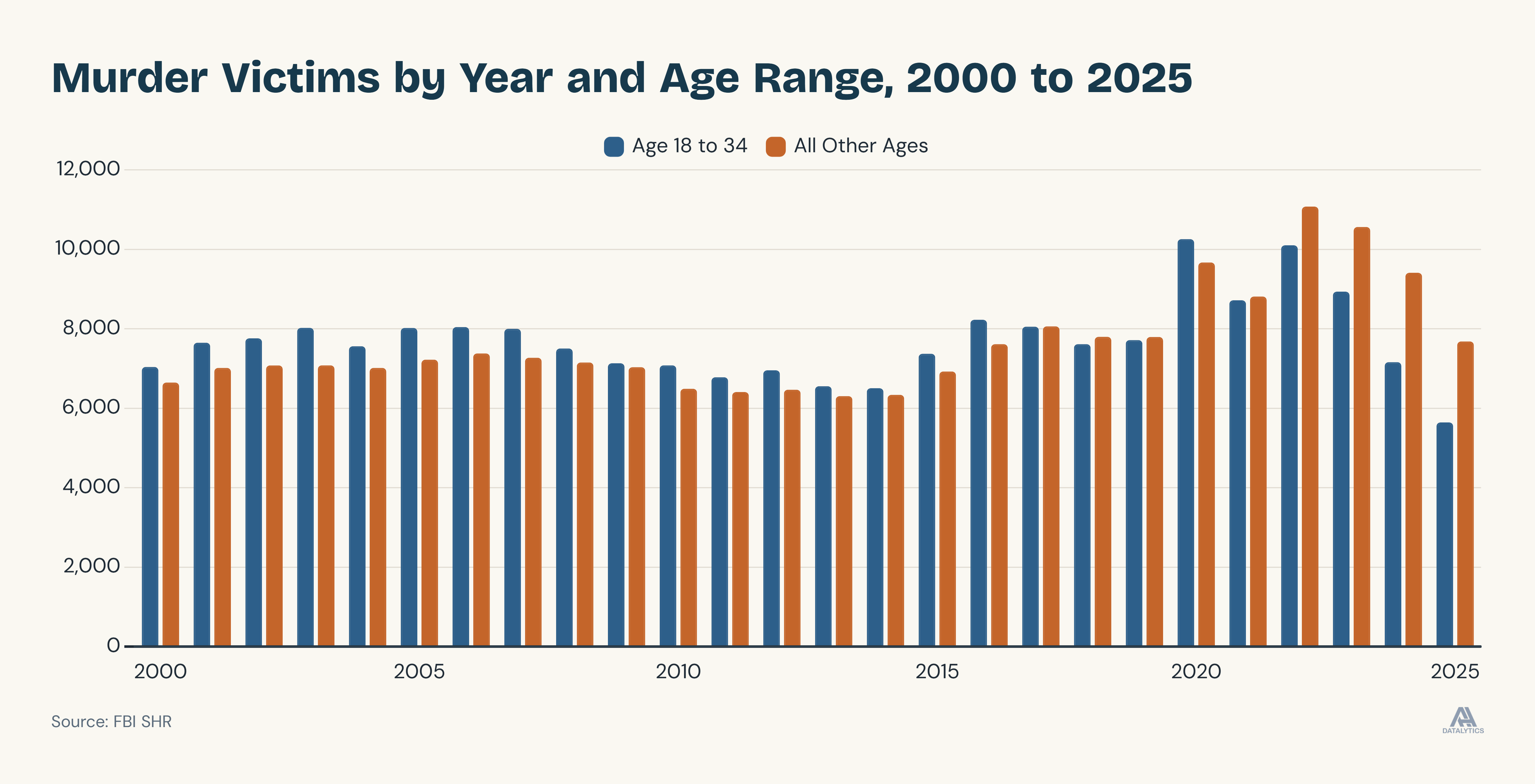
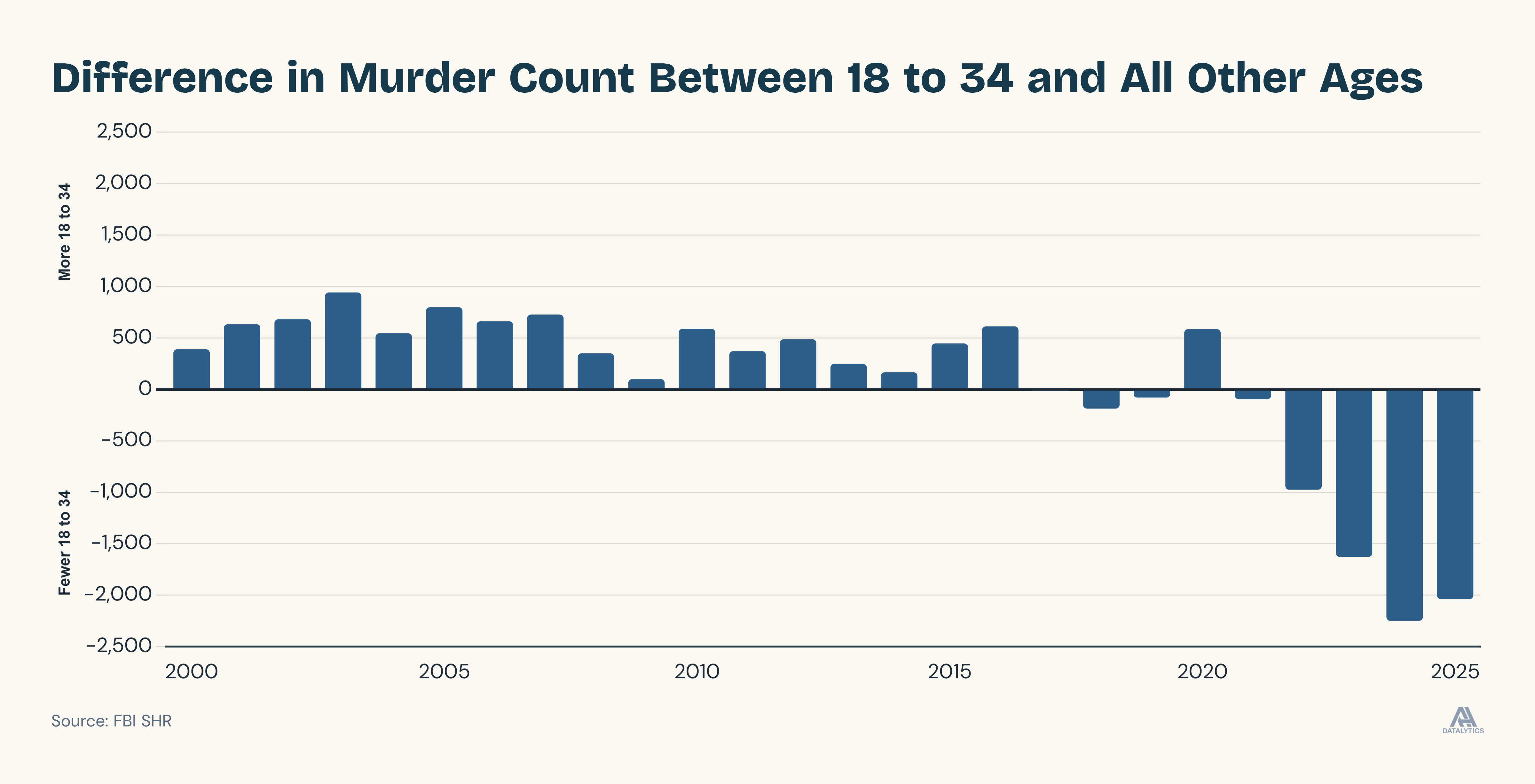
Usually they’ve been about even, but over the last few years a large gap has opened up. Young adults are still killed at a much higher rate than everyone else, but the raw numbers are falling a lot. Breaking down murders into reasonably similarly sized buckets shows just how much it has fallen amongst people in their late teens to early thirties compared to every other age range.
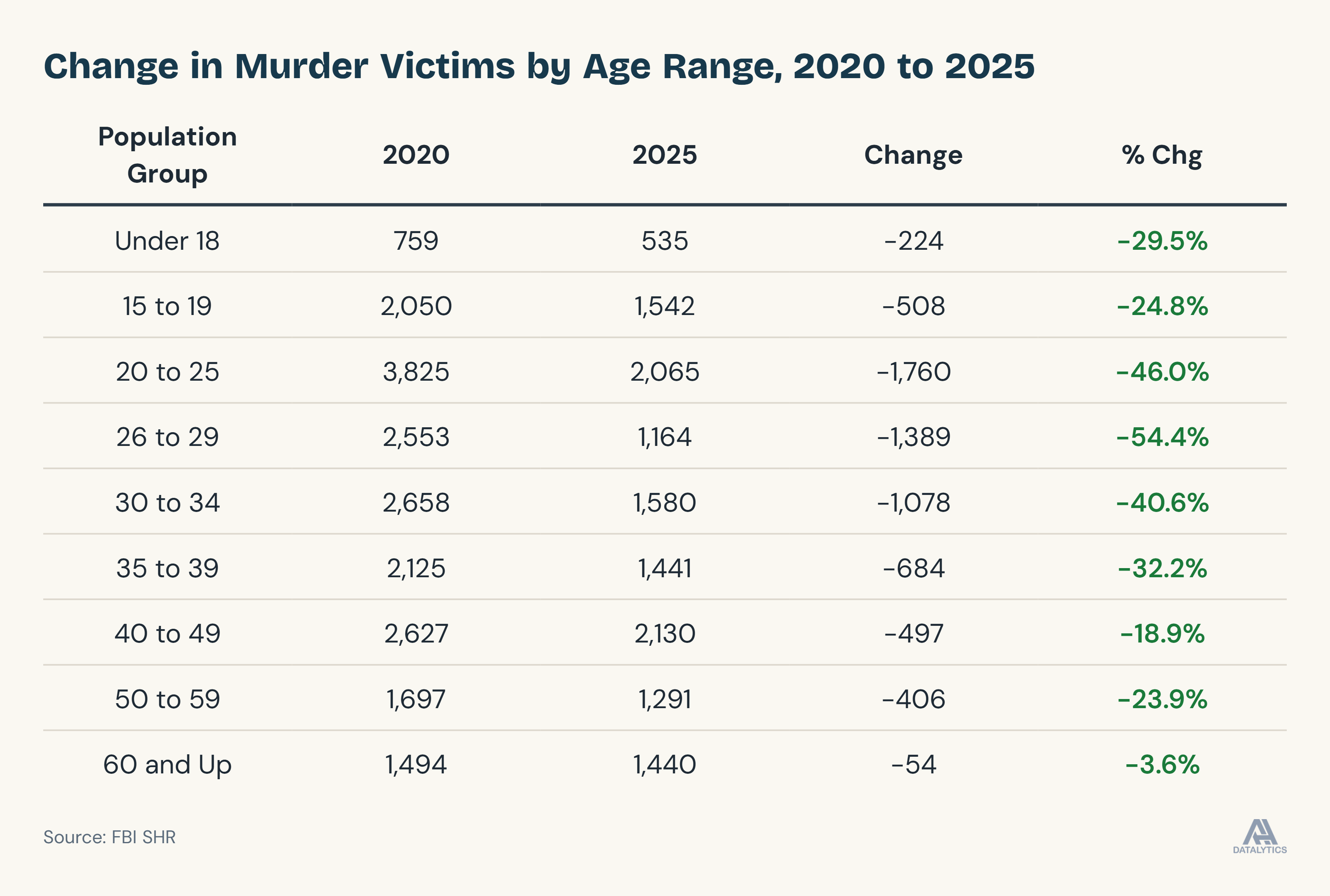
There were 45 percent fewer young adults murdered in 2025 than in 2020 according to the FBI’s Supplementary Homicide Report compared to a 21 percent drop for all other age groups. There were more than 20 percent fewer young adults aged 18 to 34 murdered in 2025 than in 2019 while all other ages were roughly even (down 1 percent) compared to their pre-COVID total.
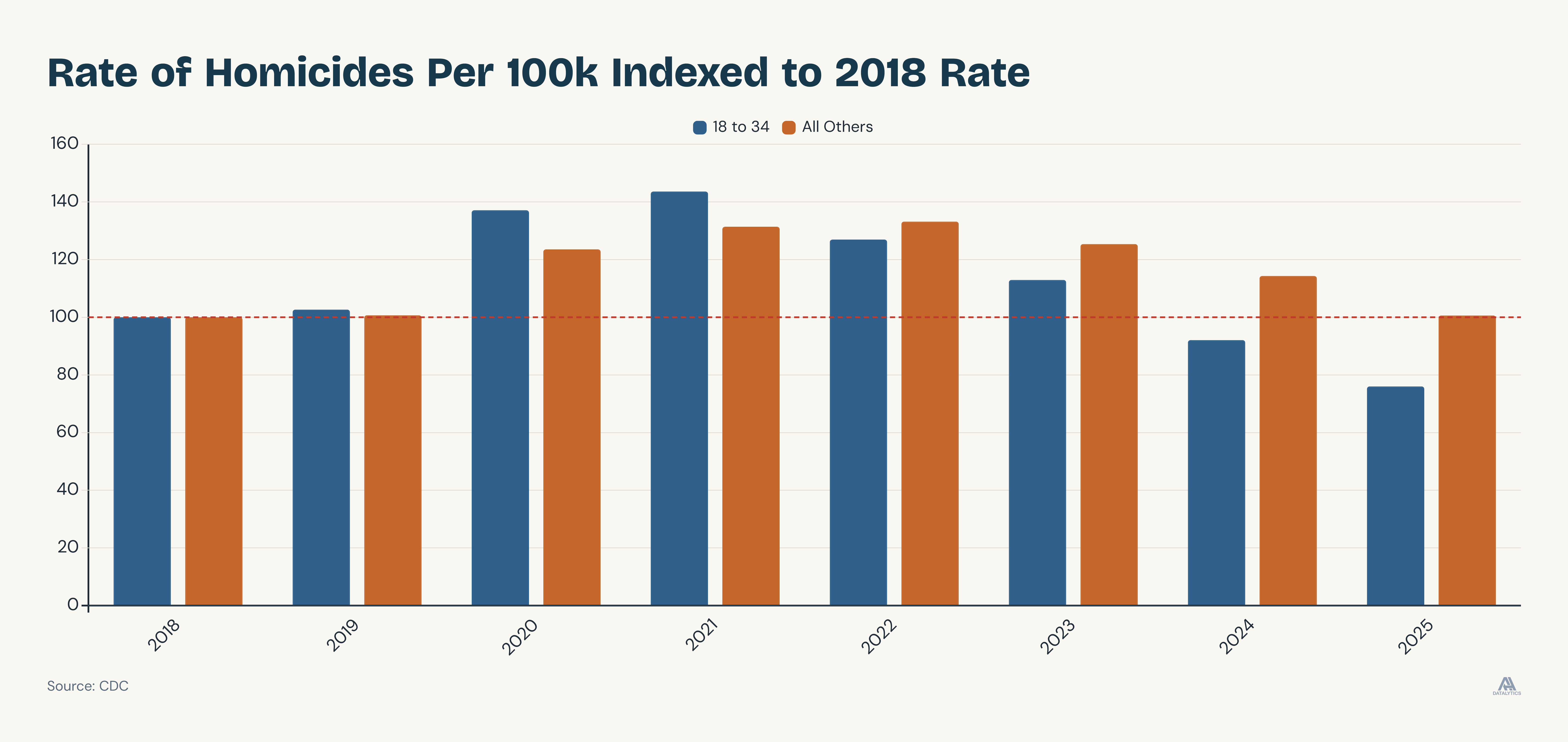
And it’s not just the FBI that shows this. The CDC has excellent homicide victimization data by age and it shows the young adult homicide rate well below its 2018 level while all other age groups are just back to it.
Jens Ludwig (former podcast guest, insert shameless plug here) has a new working paper out called “Crime in COVID Times.” In it, he talks about what might have gone wrong to lead to such an explosion in murders in the United States in 2020, 2021 and 2022. I’m less interested in that question for the sake of this piece than I am in his hypothesizing what might be bringing murder down right now which Jens also discusses.
Two possible explanations that Jens brings up stick out to me. First, he says it “could potentially be due at least in part to the large post-pandemic increases in behavioral health treatment (including through the growing use of telehealth), which has increased most sharply among the younger age groups that are disproportionately involved in violence.”
Opinion alert — I’m not that old, but even in my geriatric millennial age cohort there feels like there are unfortunate stigmas attached to seeking professional mental health assistance. It heartens me to see that younger generations don’t seem to have that stigma attached. My cursory review of the literature suggests there may be some truth to that hypothesis, but I’m far from an expert on it.
The other thing Jens discusses is how “changes in technology, specifically the role that social media, streaming services and video games play in leading more Americans – especially young Americans – to spend time alone. There is existing research suggesting that such technologies, by increasing the value of leisure time at home, can help explain declines in employment rates among young men (Aguiar et al., 2021; see also Sharkey 2024). The behavioral model of crime says: Fewer social interactions, particularly among young people, fewer social frictions. Is it possible that this could be a big-picture trend operating in the background over the past decade, whose violence depressing effects were temporarily obscured by the disruptions of the pandemic?”
It’s certainly an interesting idea though it’s obviously one that is in the very early stages of potentially explaining a change in crime. Young adults being less sociable is not great for our society, but it could also plausibly be leading to less violence in those age ranges that are most prone to it.
Fewer young people being out and about leading to less murder would seemingly run counter to research on curfews that Jennifer Doleac did a decade ago. She found that “juvenile curfews are counterproductive for public safety. When the curfew switches [from midnight to 11 p.m. in Washington in September] gun violence goes up during the 11 p.m. hour…Having people around helps deter crime by increasing the likelihood that an offender will get caught. Curfews incentivize law-abiding citizens to be at home instead of out on the streets.”
In other words, young adults playing video games and skeeting instead of being out with friends could plausibly cut both ways.
There are tons of other contributing factors. There is, for example, evidence that GLP-1s may lead to lowered violent impulses which, on the margins, may potentially be contributing a bit to the numbers we are seeing.
It also could more simply be generational improvements, for lack of a different phrase. A recent paper from Shawn Bushway, Jason Robey and Keith Humphrey finds that “current declines in crime and incarceration are driven primarily by cohort nonreplacement: Each successive generation has entered adulthood with substantially lower propensities for criminal involvement than the high-crime cohorts of the 1980s and 1990s.”
In other words, for whatever reason(s), the kids are alright and murder is plunging nationally as a result.
New on the Jeff-alytics podcast
Most Americans have never heard of the Major Crimes Act. Passed in 1885, it stripped Native American nations of the right to prosecute felony crimes on their own land and handed that authority to the federal government where it has stayed ever since.
David Heska Wanbli Weiden has spent his career trying to address that.
Thanks for reading Jeff-alytics! Subscribe for free to receive new posts and support my work.
An enrolled citizen of the Sicangu Lakota nation, David was raised in a working-class Denver neighborhood, became the first in his family to earn a college degree and then a PhD, spent decades as a professor, and eventually began writing novels to put these issues in front of millions of people who would never read a law review article.
His debut novel, Winter Counts, became a national bestseller and his newest novel, Wisdom Corner, is out now.
In this episode, we get into how a 140-year-old law shapes criminal justice on reservations today, why private vigilante justice exists where the formal system falls short, and how fiction can be a powerful data communication tool.
This was very good. I’m partial to the idea that scrolling vertical video on social media is keeping a portion of at-risk teens at home and reducing risk-seeking behavior.
Is there data showing that drastically more teens/young adults are doing therapy than a decade ago? Honestly quite curious about this as well.
To focus on the recent drop everyone needs to know the MAIN STORY, IMO of the last 35 years in America. A massive drop in crime and a massive rise in safety.
The Murder rate has been dropping since 1991; and the most drastic drops were 1990s. A complete societal shift occurred. 9.8 per 100K in 1991 to 5.5 in 2001. The decline in NYC is 2245 killed in 1991 vs 642 in 2001. MASSIVE. Gentrification 2002-present would be impossible in the climate of the 80s and 90s.
One possibility: the number of abortions really skyrocketed in the 1970s after Roe v Wade and there were less people born into unfavorable parenting circumstances. Killers are usually young, around 38% are 18-25 and another 33% are 26-34. Older people are less likely to kill.
You pose the question today WHY crime is dropping and many people, especially teenagers themselves, will claim video games and Iphones are the reason why youth crime keeps dropping. BUT the digital pacifier didn't really exist in 1990s-00s.
In my experience, crime was just cool in my youth. My world was middle class, no social ills like poverty and broken homes. YET, crime was cool. I went to a selective Bronx High School of Science, alumni are ivy leaguers, powerful executives, doctors, corporate lawyers. But as teens: Shoplifting, theft of all kind was rampant and cool. Kids bragged about what they stole. Drugs of course, drug dealing. One acquaintance was murdered but at least 8 in my wider social world did time for attempted murder. I DO think there's been a societal shift in that crime isn't as cool in middle class America the way it was. In poverty stricken regions of America, like the rest of the world, crime and murder are always endemic. I found out recently that the idyllic villages my grandparents fled to America had the SAME ills, murderous feuds as pointless as the teen gang murder beefs of every city.
I still think abortion is a massive part of the story: I used AI to put the numbers together.
YEAR Abortions (per 100k) Year Murders per 100K
**1970** | 193,491 | **453** | **1987** | **8.3** |
| **1971** | 485,816 | **1,114** | **1988** | **8.4** |
| **1972** | 586,760 | **1,316** | **1989** | **8.7** |
| **1973** | 744,600 | **1,633** | **1990** | **9.4** |
| **1974** | 898,600 | **1,928** | **1991** | **9.8** *(Peak)* |
| **1975** | 1,034,200 | **2,172** | **1992** | **9.3** |
| **1976** | 1,179,300 | **2,419** | **1993** | **9.5** |
| **1977** | 1,316,700 | **2,642** | **1994** | **9.0** |
| **1978** | 1,409,600 | **2,767** | **1995** | **8.2** |
| **1979** | 1,497,670 | **2,879** | **1996** | **7.4** |
| **1980** | 1,553,890 | **2,928** | **1997** | **6.8** |
| **1981** | 1,577,340 | **2,925** | **1998** | **6.3** |
| **1982** | 1,573,920 | **2,877** | **1999** | **5.7** |
| **1983** | 1,575,000 | **2,845** | **2000** | **5.5** |
| **1984** | 1,577,180 | **2,815** | **2001** | **5.6** |
| **1985** | 1,588,550 | **2,801** | **2002** | **5.6** |
| **1986** | 1,574,000 | **2,741** | **2003** | **5.7** |
| **1987** | 1,559,110 | **2,693** | **2004** | **5.5** |
| **1988** | 1,590,750 | **2,737** | **2005** | **5.6** |
| **1989** | 1,566,870 | **2,685** | **2006** | **5.8** |
| **1990** | 1,608,620 | **2,739** *(Peak)* | **2007** | **5.7** |
| **1991** | 1,556,510 | **2,634** | **2008** | **5.4** |
| **1992** | 1,528,930 | **2,589** | **2009** | **5.0** |
| **1993** | 1,495,000 | **2,525** | **2010** | **4.8** |
| **1994** | 1,423,000 | **2,397** | **2011** | **4.7** |
| **1995** | 1,359,440 | **2,282** | **2012** | **4.7** |
| **1996** | 1,365,700 | **2,276** | **2013** | **4.5** |
| **1997** | 1,335,000 | **2,227** | **2014** | **4.4** |
| **1998** | 1,319,000 | **2,195** | **2015** | **4.9** |
| **1999** | 1,314,800 | **2,187** | **2016** | **5.4** |
| **2000** | 1,312,990 | **2,130** | **2017** | **5.3** |
| **2001** | 1,291,000 | **2,088** | **2018** | **5.0** |
| **2002** | 1,269,000 | **2,049** | **2019** | **5.1** |
| **2003** | 1,250,000 | **2,017** | **2020** | **6.5** |
| **2004** | 1,222,100 | **1,969** | **2021** | **6.8** |
| **2005** | 1,206,200 | **1,941** | **2022** | **6.3** |
| **2006** | 1,242,000 | **1,990** | **2023** | **5.7** |
| **2007** | 1,209,640 | **1,950** | **2024** | **5.0** |
| **2008** | 1,212,350 | **1,940** | **2025** | **4.1** |
---
Also they claim lead paint and leaded gasoline fumes made people commit more crime. But I have to say, the murders would be lower if the culture shift in middle class occurred in lower class. A LOT of poor kids buy in to gangsta rap culture. A 13 yr old boy was murdered at 7am last september for ridiculous street cred by a 16 yr old because the boy lived in the next door neighborhood. The stupid teen gang phenomenon, where every 10-20 block microneighborhood and/or housing project creates its own silly identity that is at war with all its neighboring equals. Usually beatings but often stabbings and eventually shooting. In the BX and Especially Chicago the escalation to murdering creates its own momentum of grief and revenge that goes on for generations; and cannot be stopped easily.
These are not gangs as most understand Gangs, as in this isn't organized crime, this isn't the Mafia or triads or whatnot. Its just targeting kids from the neighboring slums and housing projects; wearing the wrong color. Every boy is a potential victim if they trespass, so every boy is sort of automatically enrolled in whatever teen group controls/lives in their 20 block radius.
I must add though, this isn't unique. High poverty rural areas around the world have had endemic Feud violence too...and firearms increased the murder rate and revenge factors.