

The drop in San Francisco vehicle burglaries is one of the more stunning crime trends I’ve seen. There were nearly 30,000 vehicle burglaries reported in San Francisco Police Department’s open data in 2019. There have been around 5,000 in the last 12 months, an astounding drop in just a few years.
Like, look at this chart!
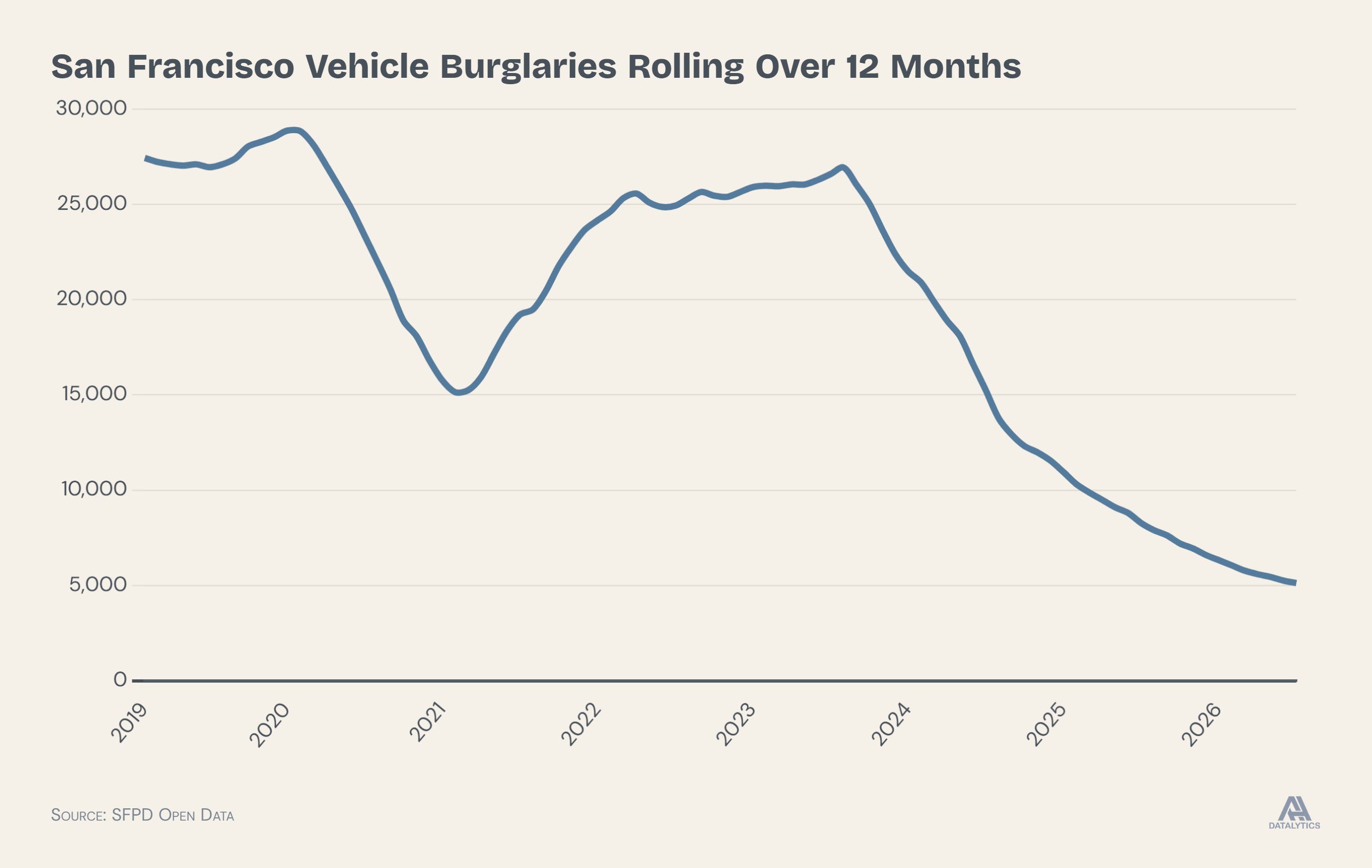
It’s so sudden and so steep that it almost makes you think there’s a change in reporting or a data entry error. But there's no reason to think it isn't a real trend, especially because the very same trend in vehicle burglaries is happening pretty much everywhere.
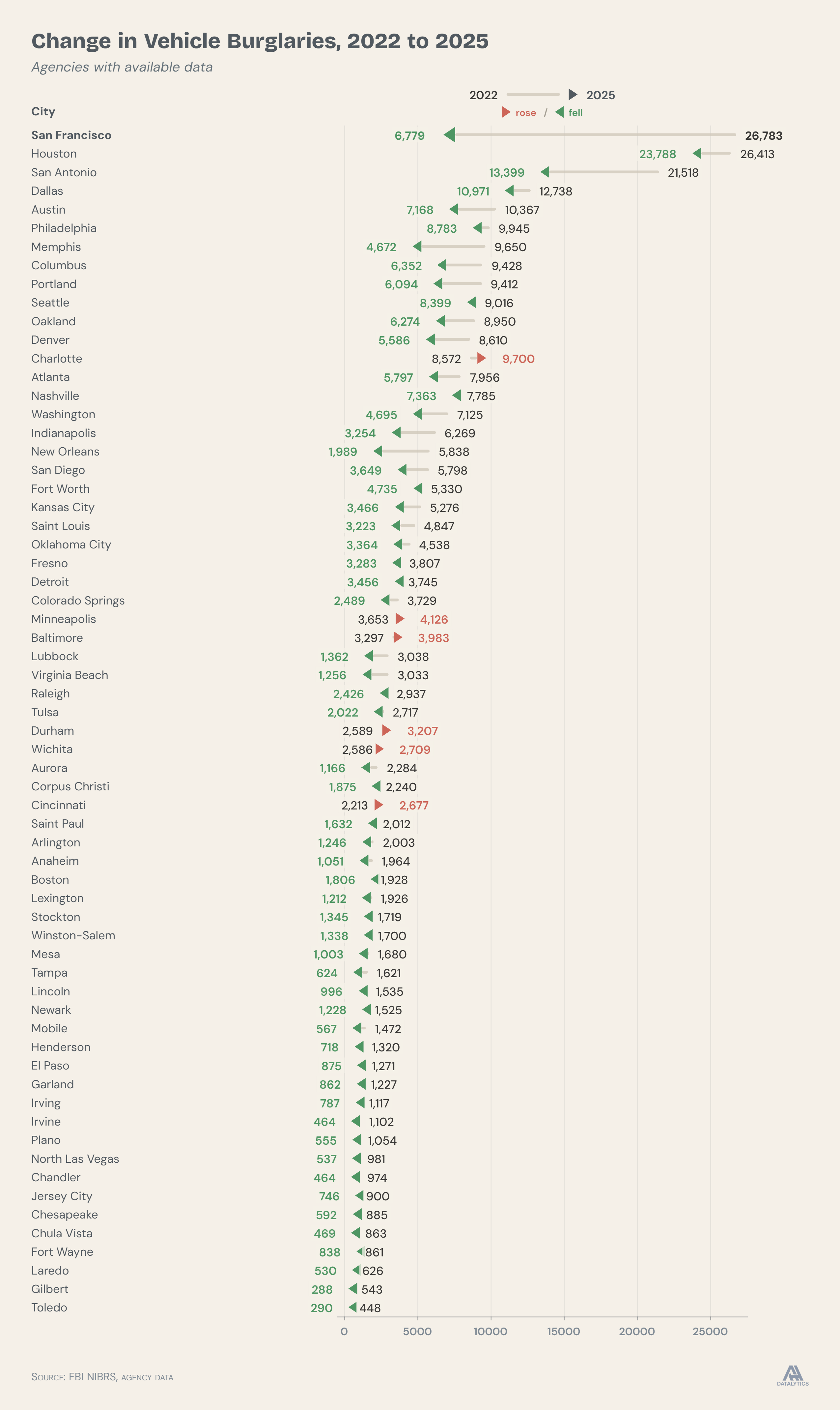
And while a decline in vehicle burglaries is happening everywhere, it’s happening more in San Francisco than anywhere else. San Francisco had the highest number of reported vehicle burglaries of any large city with available data in 2022 and no city has seen a larger drop (though almost every city with data has seen some decline since 2022). Below is a graph vehicle burglary counts in 2022 and 2025 for every big city of 250,000 or more that reported data both years to the FBI (note I added in San Francisco to illustrate the point and New Orleans because I live there from other sources. I didn't grab data from cities like New York and Chicago that only recently joined NIBRS).
The critical question is why?
The San Francisco Standard has a terrific writeup of vehicle burglaries in San Francisco with local flair and explanations from local policymakers. They largely attribute the drop to improved surveillance, enforcement, and prosecution. From the piece:
The SFPD increased patrols in bipping hot spots like Fisherman’s Wharf starting in 2023. Cops also started using bait cars and building cases against major bipping gangs. In 2024, the department deployed its network of Flock cameras, and voters increasingly more concerned about public safety than privacy approved Proposition E, which allowed the SFPD to use drones and other types of surveillance technology.
“We are able to swiftly identify crews moving throughout the city, follow them, and make arrests when it is safe and feasible,” SFPD spokesman Evan Sernoffsky said. “Word is spreading among the criminal element that we will catch them and arrest them.”
Drones get a good share of attention in the article. One man makes the below comment:
“I feel like it’s a wrap,” Berner said, citing the cops’ increasing use of drones and cameras. “Everything’s being recorded and documented. If you’re doing crime these days, I don’t know, man. It’s kind of crazy.”
And there’s this graphic (that I don’t particularly love because it actually pretty strongly points to something other than drones being responsible):
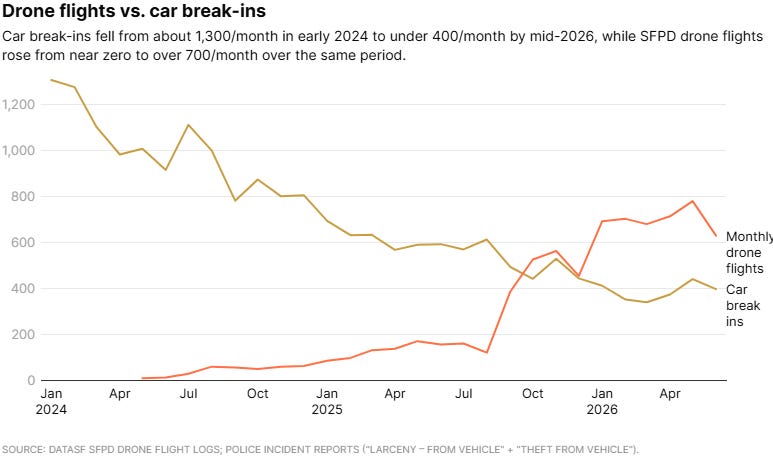
The overarching theme of explaining the drop in vehicle burglaries is that new surveillance technology, combined with improved enforcement efforts, is leading to fewer vehicle burglaries in San Francisco. It makes for a neat story, but there are a few data-related reasons that I’m skeptical about this explanation. To be clear, I’m not evaluating the overall usefulness of these technologies for law enforcement, but I did look at whether they make sense as primary explanation for why vehicle burglaries are plunging in San Francisco.
Let's start with drones.
The first reason I’m skeptical is that drones are particularly poorly suited for responding to vehicle burglaries. Vehicle burglaries usually occur at night but they are reported during the day. To see this I grabbed vehicle burglary data from San Francisco’s open data portal for 2025 and 2026 and built a bar chart of the share of offenses occurring in each hour of the day broken down by the time they were believed to have occurred and the time they were reported to police. I removed all incidents with an occurrence time of exactly midnight because they’re probably disproportionately unknown times and there were a fair number of them.
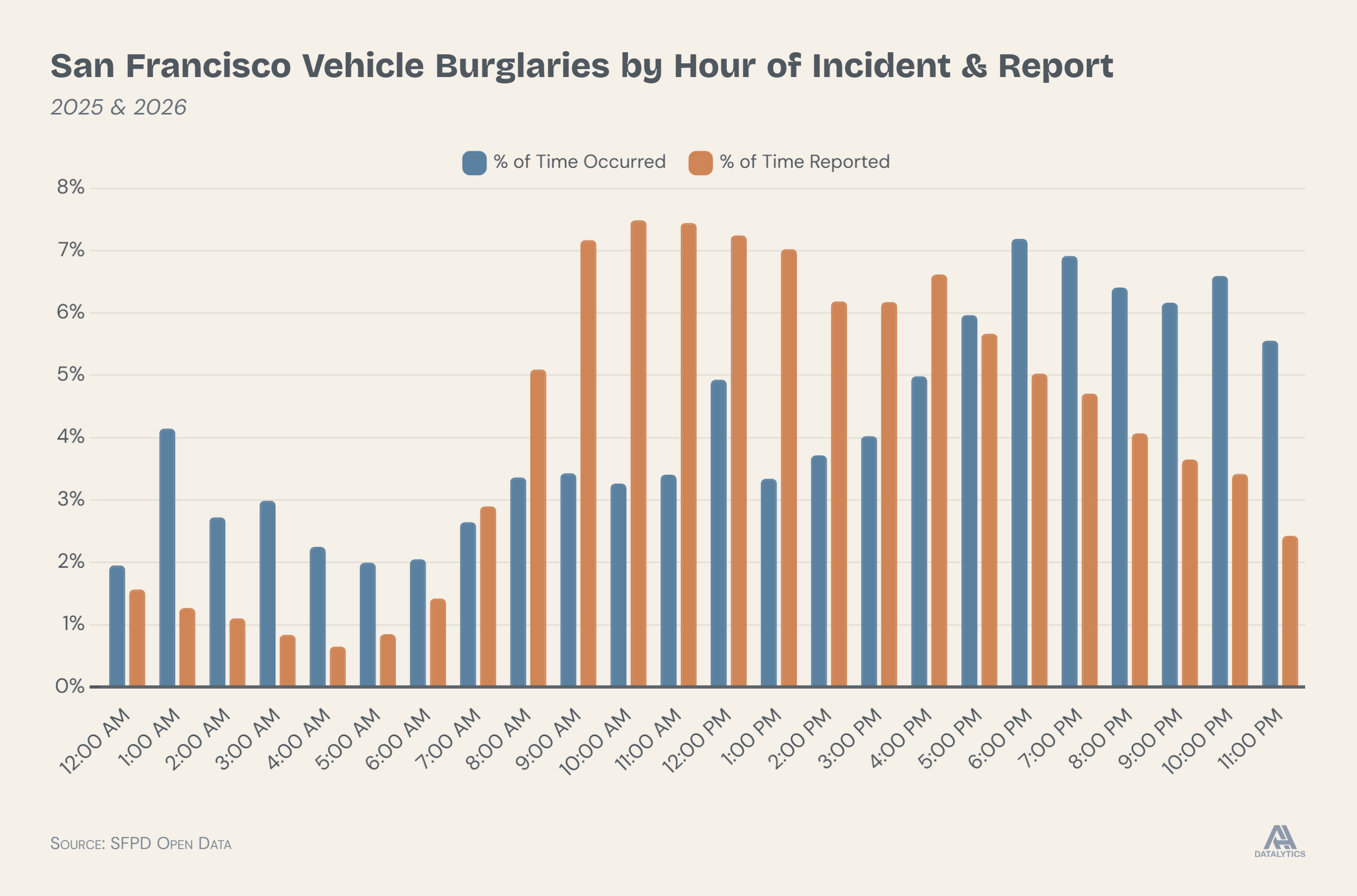
More than half (56 percent) of vehicle burglaries were reported to have occurred roughly at night between 6 PM and 6 AM but only 26 percent of vehicle burglary reports were made during that timeframe. This lag between occurrence and reporting time is part of what makes vehicle burglaries so difficult to solve — your car is broken into at 11 PM but you don’t see it until you go to work at 8 AM.
The median time from occurrence to report for vehicle burglaries in San Francisco is 17 hours. Drones won’t have much impact on vehicle burglaries other than to note that the perpetrator(s) of last night’s vehicle burglary are no longer in the area.
San Francisco maintains really good data on drone flights which allows us to better see why drones are an unlikely cause. There were nearly 7,500 drone flights in San Francisco between the start of June 2024 and the end of June 2026. Just 176 were related to a vehicle burglary (or AUTO BOOST / STRIP in SFPD’s language) though. That represents about 2 percent of all drone flights over that span and points to a drone being used in about 1 percent of all vehicle burglaries.
A plurality of drone flights (about a third) are dedicated to responding to suspicious persons/vehicles or persons with a weapon which is a more sensible use for these tools than responding to last night’s vehicle burglaries. Drones in San Francisco make a nice, simple explanation for the vehicle burglary trend but not a strong one in my opinion.
Another assertion raised in the piece is that law enforcement and prosecution is catching up to vehicle burglars leading to more arrests and fewer crimes. One challenge with measuring arrest or clearance rates with crimes like vehicle burglaries and auto thefts is that a perpetrator may have committed scores of other offenses but cannot be tied to them. Someone who has committed 25 vehicle burglaries may get arrested on attempt number 26 and the first 25 may not make it into the official clearance statistics.
If police and prosecutors have broken up groups committing large amounts of vehicle burglaries — as is stated in the article — then that could have an outsized impact that’s difficult to measure in clearance rates. Additionally, similar groups of people commit auto thefts and vehicle burglaries, so deterring someone from committing the former may deter them from the latter in a way that is not easy to measure.
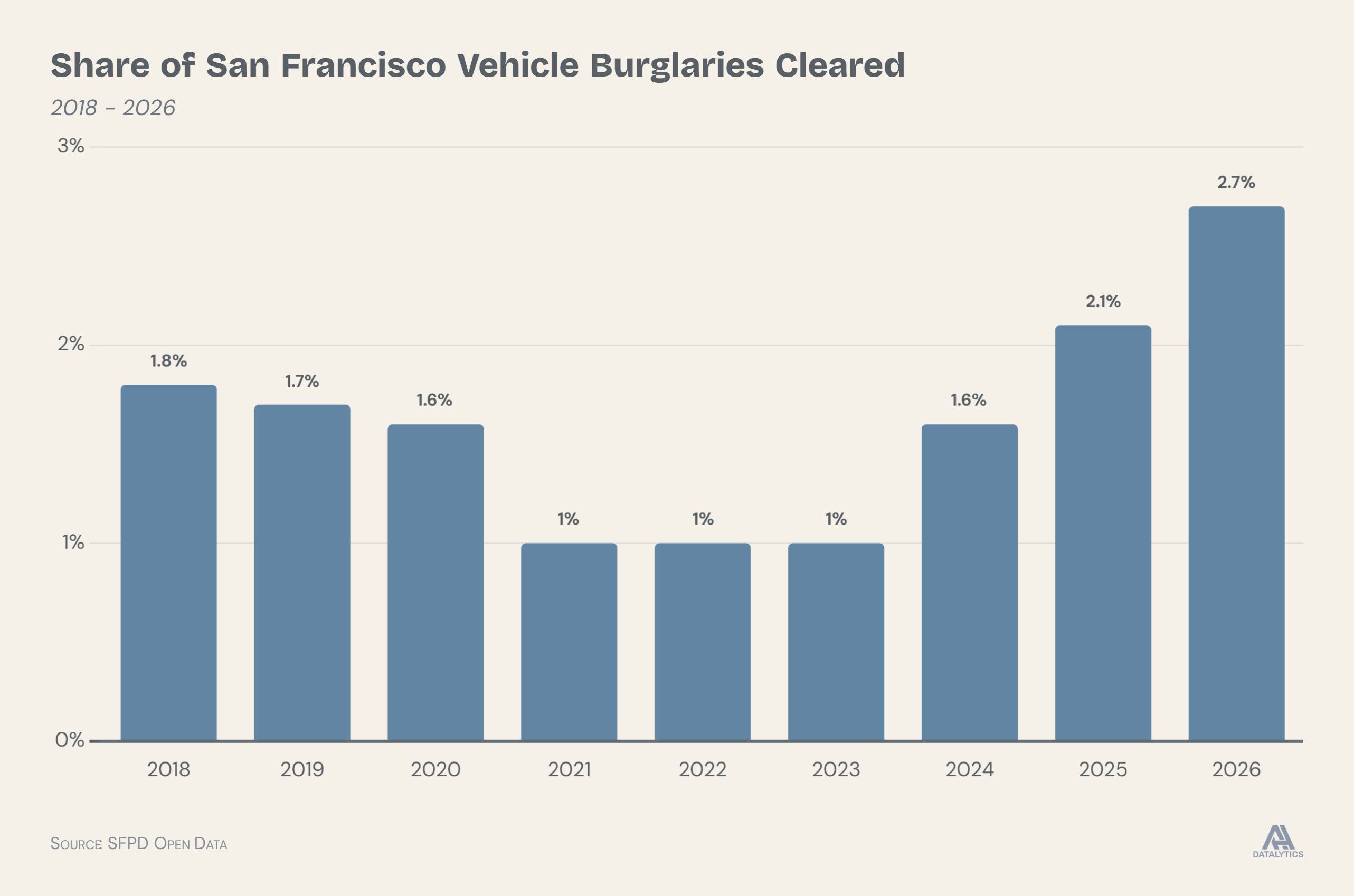
With that disclaimer out of the way, it’s hard to see a game-changing movement in how much deterrence is coming from increased enforcement of vehicle burglaries. The good news is that the arrest rate for vehicle burglaries in SFPD’s open data has improved dramatically over the last few years.
The bad news is that it is still pretty woeful.
San Francisco isn’t alone in reporting very low vehicle burglary clearance rates. Houston, Kansas City and Denver all reported around 1 percent of 2025 vehicle burglaries as cleared and Dallas reported 1.5 percent. Philadelphia was at 2.2 percent and St Louis reached an astounding 4 percent in 2025. Overall, San Francisco’s much higher vehicle burglary clearance rate was about average for cities of 250,000 or more. All of the cities with high vehicle burglary clearance rates have small numbers of reported crimes.
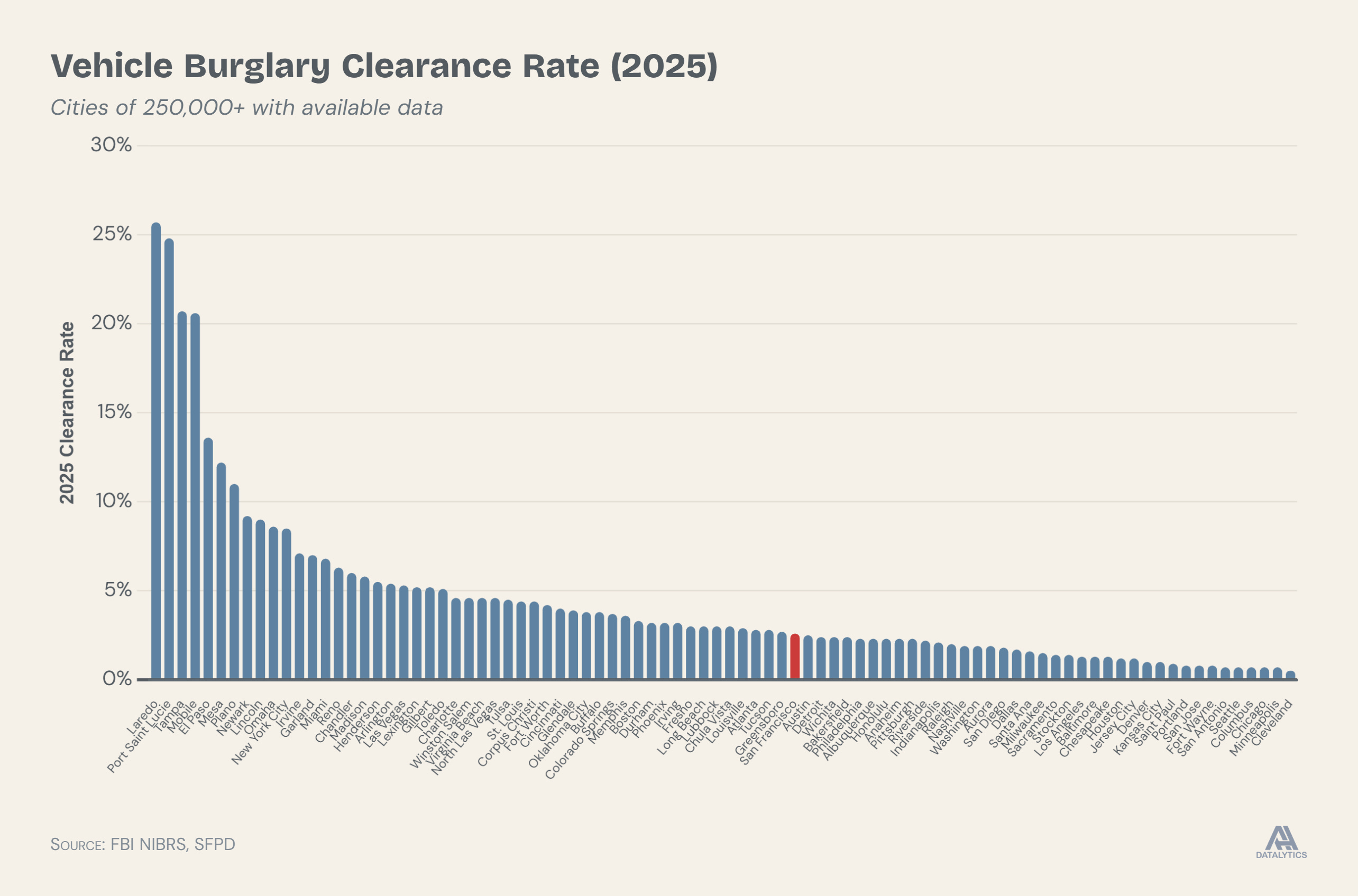
The bottom line is that vehicle burglaries are rarely solved by law enforcement in pretty much every large city. If the swiftness and certainty of getting caught is the strongest deterrent, then what deterrent effect can enforcement and prosecution have on a crime where only 1 in 50 ends in an arrest? Are criminals aware of and deterred by the fact that their risk of getting caught in San Francisco went up from 1 to 2 percent?
Maybe, but I’m skeptical.
New surveillance technologies could absolutely be one contributing factor in falling vehicle burglaries. Recent research from Ian Adams and Scott Mourtgos does suggest license plate readers like Flock’s can reduce auto theft and increase auto theft clearance rates (here’s a nice writeup by them). They conclude that “Using staggered adoption across 216 agencies, we estimate that fixed ALPR deployment is associated with an 11.0 percent decline in motor vehicle theft and a 15.9 percent increase in arrest clearance.”
It makes sense that license plate reader technology could be useful for identifying a stolen car driving past it, but a car that has been broken into doesn’t move past an ALPR camera. Maybe the proliferation of numerous types of cameras — including license plate readers — working together is improving the solvability of these crimes. Maybe deterring auto thefts also deters other crimes by proxy. Maybe, but I would wait for stronger data and research before firmly making that connection.
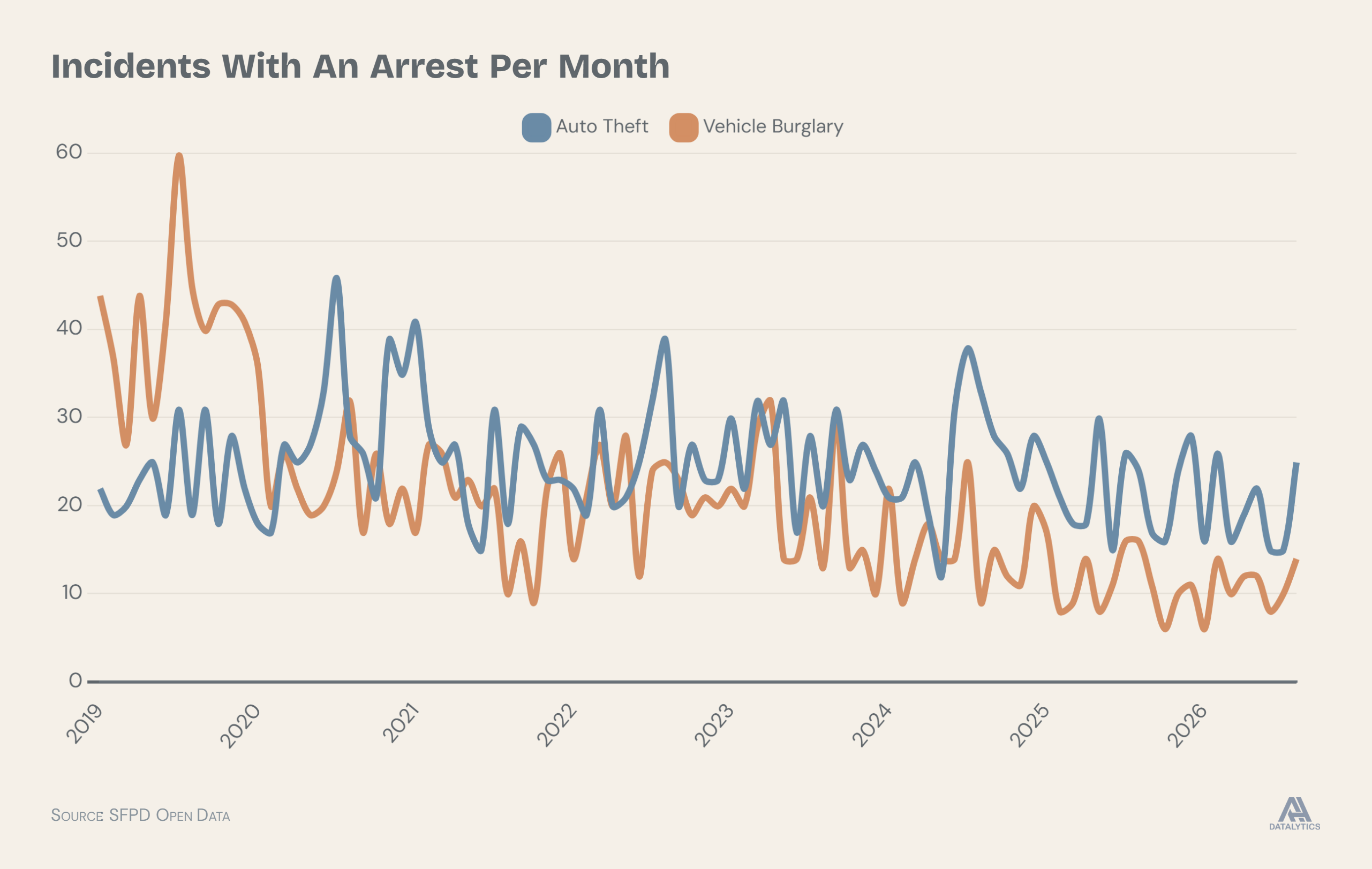
You can make a data-driven argument that the installation of Flock cameras in 2024 did potentially contribute to higher arrest rates in vehicle burglaries in San Francisco, but the effect was far more muted compared to the apparent impact on auto theft arrests. Below is the share of incidents cleared by arrest rolling over 12 months with the shaded region representing the 90 day stretch in 2024 where the flock cameras were installed.
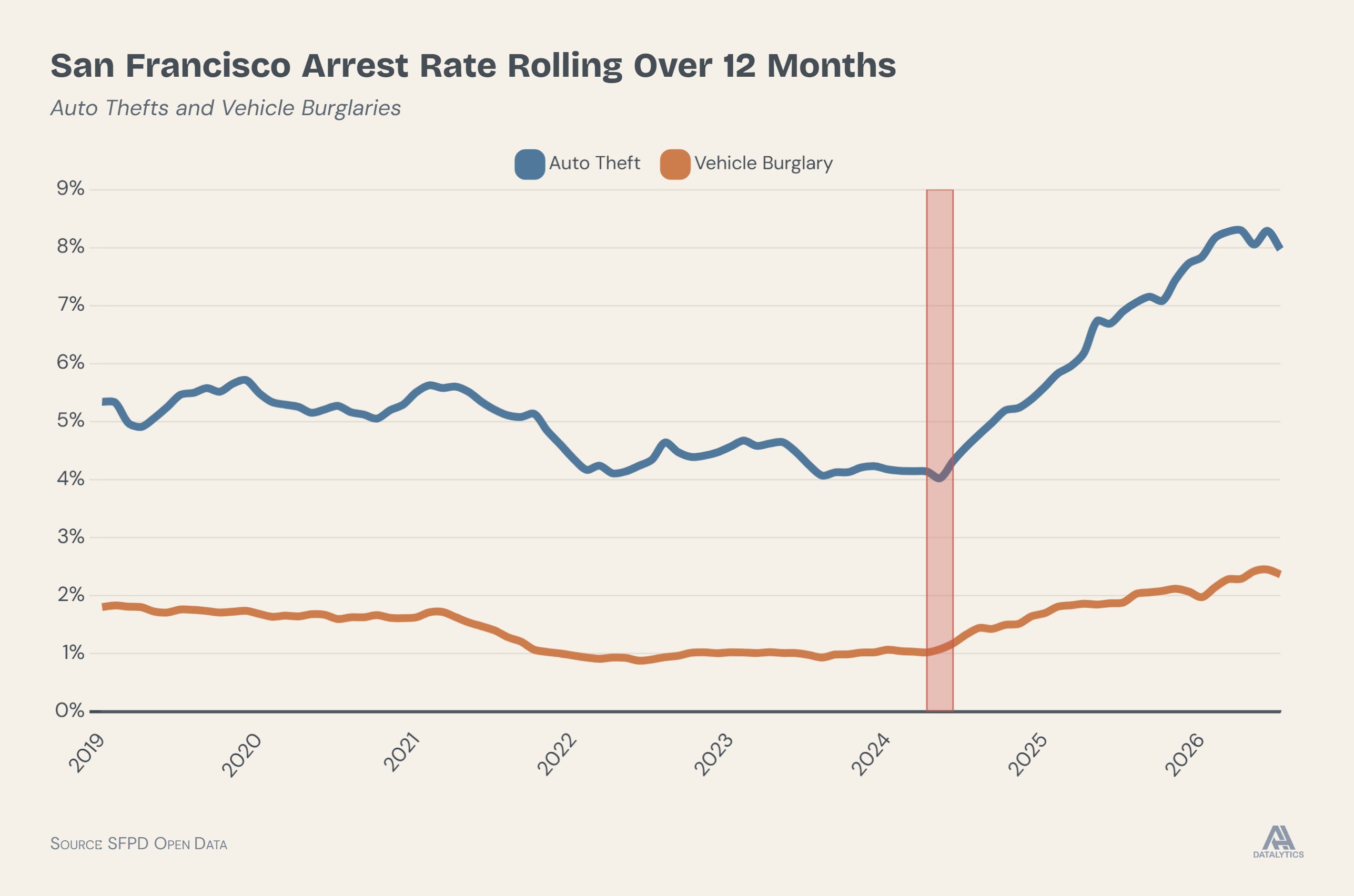
It is, however, a bit of a chicken and egg thing. Fewer crimes usually leads to a smaller denominator in the arrest rate formula and and higher reported rates. And while the timing matches up for auto theft and vehicle burglary clearance rates rising after the cameras were installed, the data clearly shows the drop in crime predates the cameras. Auto thefts began declining in San Francisco before the cameras were installed and vehicle burglaries were well into their decline when the first Flock camera went up.
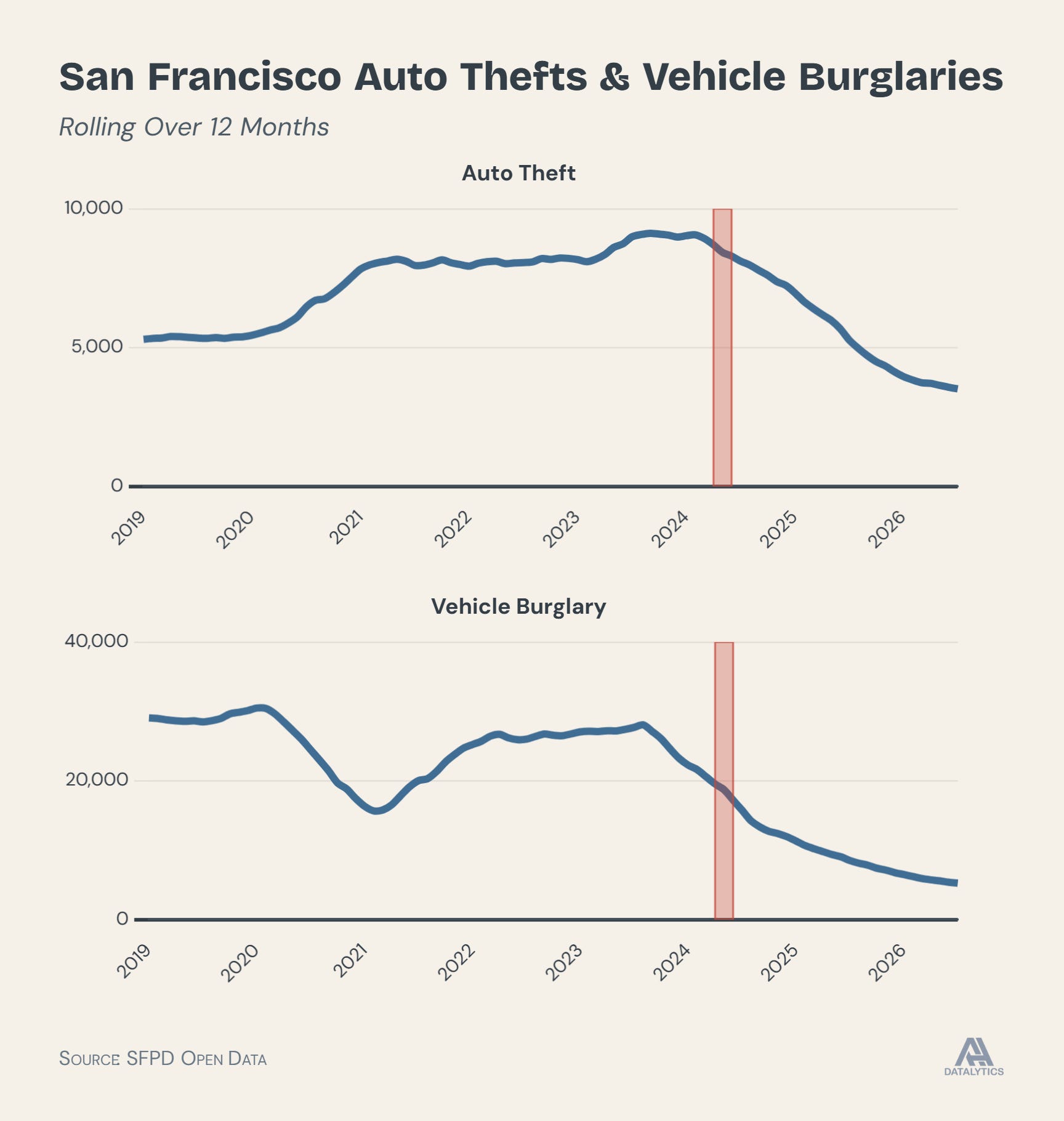
And the new cameras haven't led to more vehicle burglary or auto theft arrests, just a higher rate of incidents solved because there numerator is stable while the denominator is shrinking.
Where does all of this leave us?
I would argue that drones probably haven't had much impact on San Francisco's vehicle burglaries. The ALPR cameras could plausibly deter offenders without creating an increase in arrests, but it isn't a slam dunk case and both auto thefts and vehicle burglaries began falling before they were installed. I think the drop's cause is far more complex than an argument that installing cameras, using drones and increasing encorcement has led to higher arrest rates and fewer crimes in San Francisco.
Usually, when crime goes up or down we tend to look for the one thing that was happening around the time that the trend changed. There are, however, undoubtedly scores of other factors at play in plunging property crime in San Francisco and elsewhere in the United States. A recent paper, for example, found increased code enforcement in hot spots led to fewer 911 calls for residential burglaries and auto thefts. And physical improvements to a corridor in Fort Wayne, Indiana led to massive drops in property crime along that area.
The drop in vehicle burglaries is very real and very widespread nationwide, but the ‘why’ of this issue is far from settled. Could surveillance technology be playing a role? Absolutely. Are Flock and drones responsible for the enormous drop in San Francisco property crime? I’m skeptical. So what is playing the primary role in bringing down property crime in San Francisco and elsewhere? That is a question that is far from settled in my opinion.
New on the Jeff-alytics Podcast
The Department of Justice encompasses nearly a hundred U.S. attorney’s offices, employs thousands of prosecutors, and touches basically every dimension of public safety in America, but most people have no idea how any of it actually works.
Today’s guest, Kenneth Polite, does. A native New Orleanian who lost his brother to gun violence on the city’s streets in 2004, Ken spent the next two decades inside DOJ — from assistant U.S. attorney in the Southern District of New York to U.S. attorney in New Orleans to assistant attorney general heading the entire criminal division, overseeing 1,400 people across 17 sections and operations in over 70 countries.
In this episode, he talks about what that vantage point actually reveals: how data moves through the department, where it breaks down, and why prosecutors so rarely communicate the full scope of what they do. We also get into consent decrees, the politics of DOJ independence, and why restoring the department’s credibility is going to require more than just a change in administration.
You can also catch it on the Jeff-alytics YouTube page where I’ll be posting episodes and video clips, so be sure to like and subscribe there if you’re so inclined!
And while you’re here, be sure to check out these other recent great episodes:
Former Minneapolis Police Chief Brian O’Hara
Michigan Economist Mike Mueller-Smith
Former ATF COO Thomas Chittum
Northwestern sociologist Andrew Papachristos
This was good. Yes, I think we should be fairly skeptical that drones and alpr have a measurable impact more than a few (couple) %? Maybe add in consumer self-protection tech (AirTags) and that helps at the margin.
But the broader crime story is more of a “reversion to the mean” whereby the most prolific offenders of the early 2020s are now incapacitated in one fashion or another and the public at large has become a more capable guardian (more likely to be “fed up”, intervene or report something) than they were in the early 2020s?
I'm surprised not to see New York City on your list. Is that because there are so few vehicle burglaries in NYC? I know that NYC vehicle ownership is much lower than the rest of the country, but it's still a very big place with a lot of cars.