

One of the weird parts about the FBI’s 2025 Crime in the United States report release that stood out to me was just how little attention it got. Sure, it got some coverage in national media, but my piece on murder surging in 2020 was literally front page news (tiny paragraph towards the bottom).
Some of it is undoubtedly a propensity in our society to emphasize increasing crime and more often ignore falling crime (the media doesn’t cover the planes that land), but I don’t think that’s the entire story.
Part of it, I think, is that the FBI’s 2025 data release last month was not at all a surprise.
The first piece I wrote about the national surge in murder in 2020 came in July 2020. That was, I believe, the first time anybody had written about how much murder was rising nationally that year (there were a few other major stories in the news that year). I had a sample of 25 cities that I collected by hand in a Google Sheet and that sample found murder up 16 percent relative to 2019.
I wrote about it again in September 2020 noting that the increase would be much larger than we previously suspected (25 percent), which reflects the fact that murder at the time was rising at an astronomical pace. Still, I remember feeling surprised that the FBI’s 2020 report (published in September 2021) showed a 30 percent increase in murder that year.
My piece from 2023 in The Atlantic on how murder in the US was suddenly dropping got an enormous amount of press, much of it pushback from people who didn’t believe the story. At that point my sample had grown to 90 cities and was pointing to a large drop after murder had largely stayed at a steadily elevated level in 2021 and 2022.
Now it’s 2026 and the drop in murder seems like it is barely news. The trend itself has been happening for nearly four years at this point, so it certainly is not new, but there is also so, so, so much more crime data available now than there was just a few years ago that the old complaints about the slowness of knowing crime trends are no longer valid.
The 2025 crime trends didn’t make as much news because they weren’t really news. The first thought that came to my mind, as someone who thinks about these things, was that the crime data battle has been won.
Here’s how:
I started collecting crime data from cities that published it in 2015 when I noticed a sample of big-city data could predict national trends within a few percentage points. This entire endeavor was only possible because of the Obama administration launching the Police Data Initiative earlier that year.
The PDI was the product of Clarence Wardell and Denice Ross, two Presidential Innovation Fellows with the White House. I had Denice on the podcast a few weeks, and ago she talked about founding the PDI over cupcakes with police chiefs at the White House (around 24:30 of the above show).
This approach enabled people like me to evaluate crime trends, but it was not without its shortcomings. Not every agency published murders — some published homicide counts, counting non-murder crimes was much more difficult, and the cadence that each agency reported data was uneven. Oh, and data collection was entirely manual. The result, however, was our YTD Murder dashboard.
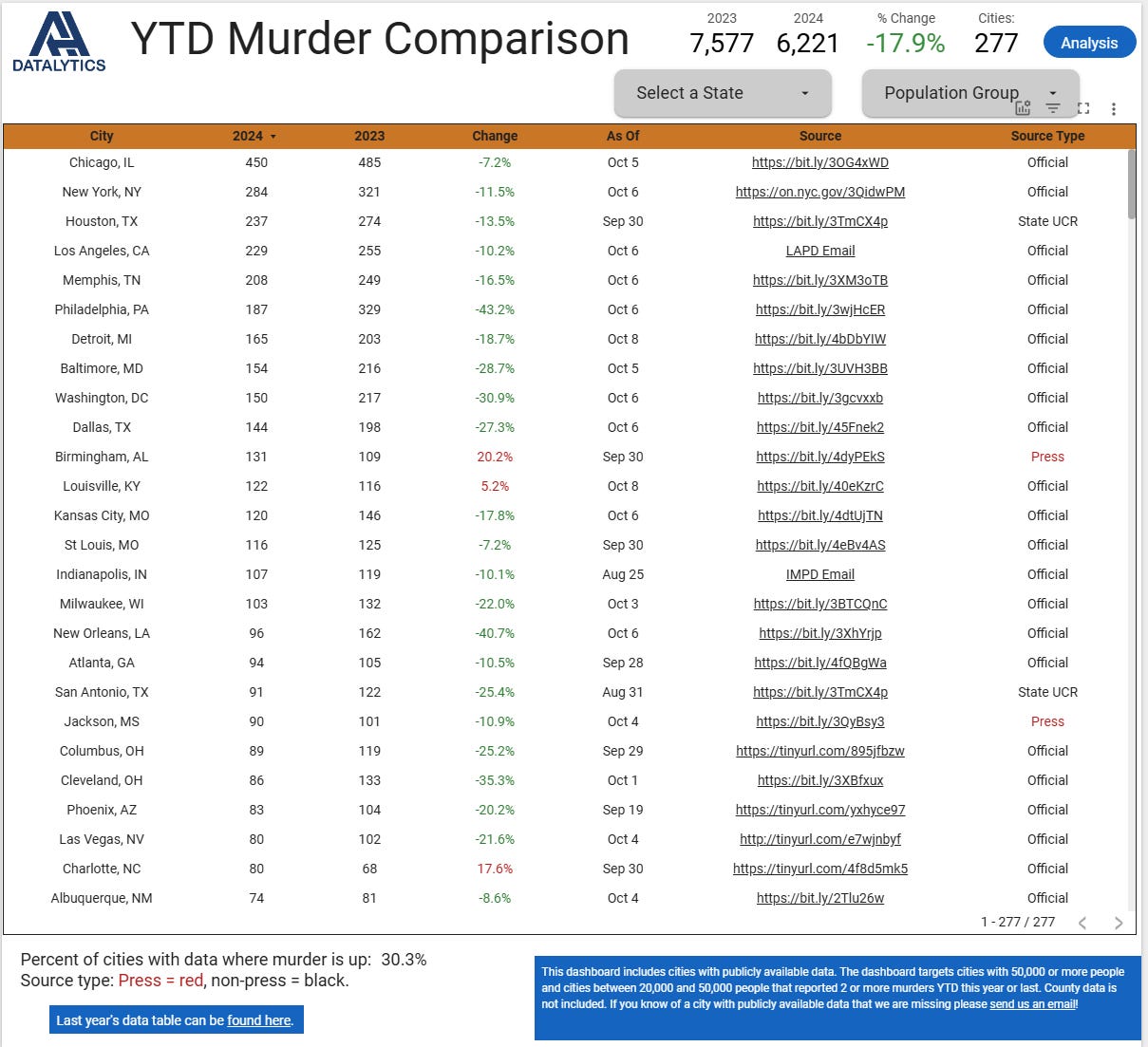
Other groups have approached the problem in similar ways. The Major Cities Chiefs Association began publishing violent crime counts for 65 to 70 large agencies in 2015. And the Council on Criminal Justice began tracking crime trends for a wider range of incident types in mid-2020 (here’s my great conversation with CCJ’s Adam Gelb).
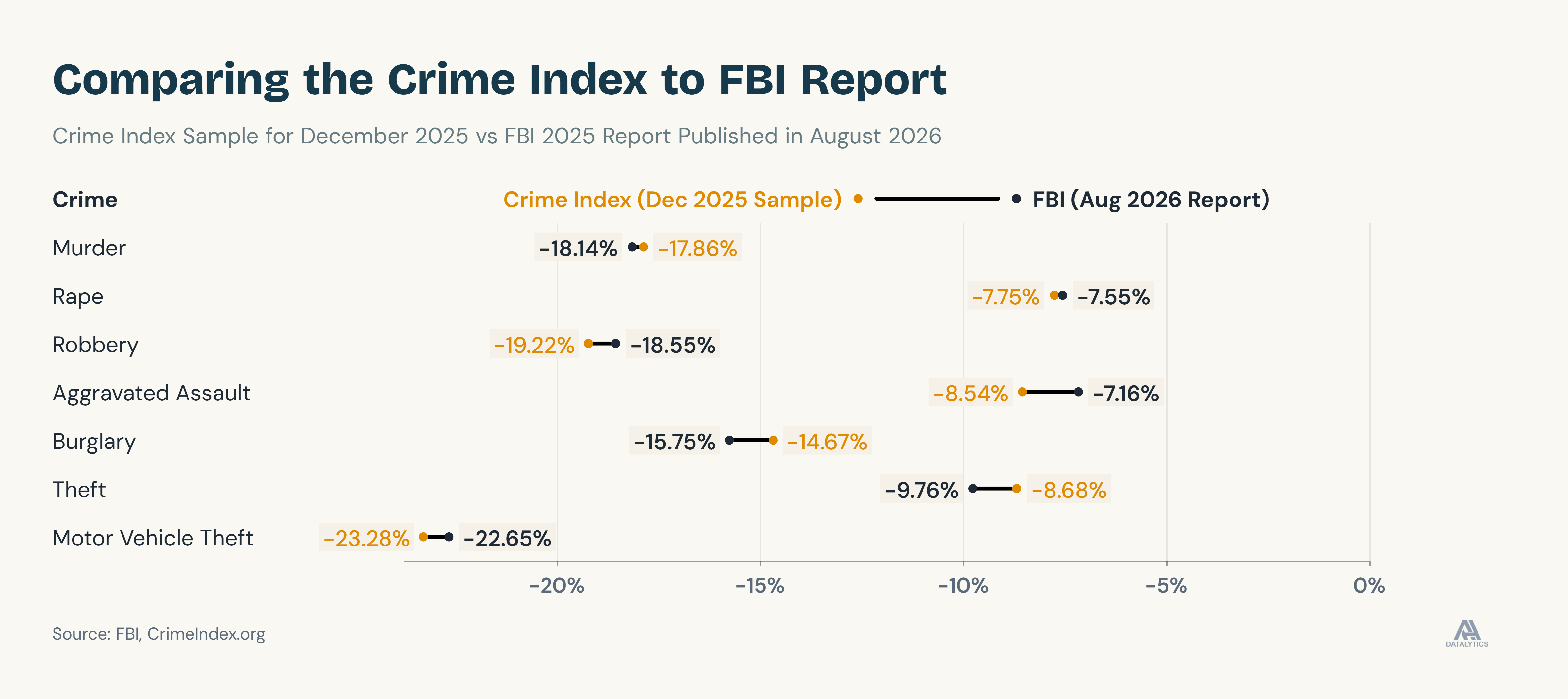
The Real-Time Crime Index (now Crime Index) that we launched in 2024 was an offshoot of all of this work. Our goal was to get data from as many agencies as possible that would be predictive of national trends. We standardized the data being collected so that it would be apples-to-apples and also standardized the timeframe so you could see the trends change over time.
The first sample of the Real-Time Crime Index had data for 301 agencies covering 76.1 million people. Last month’s sample (which was the largest sample we’ve had) had data for 590 agencies covering right around 120 million people nationwide. The result is a dataset that can accurately predict the national crime trends that the FBI will eventually report many months before the actual reports come out.
Most of this would not be possible had the FBI not embarked on the full transition to NIBRS in 2021. That year was a disaster for crime data, but it has created an environment where crime data is far more accessible now than it was 5 years ago in two critical ways.
First, the NIBRS transition forced many agencies and states to adopt modern data collection and reporting practices. Many agencies now submit data on a monthly, weekly, and even daily cadence to their states and states submit data to the FBI at a similar cadence.
Around a third of the country was covered by a NIBRS-compliant agency a decade ago. Nearly 90 percent of the country is covered now and that total is continuing to grow each year.
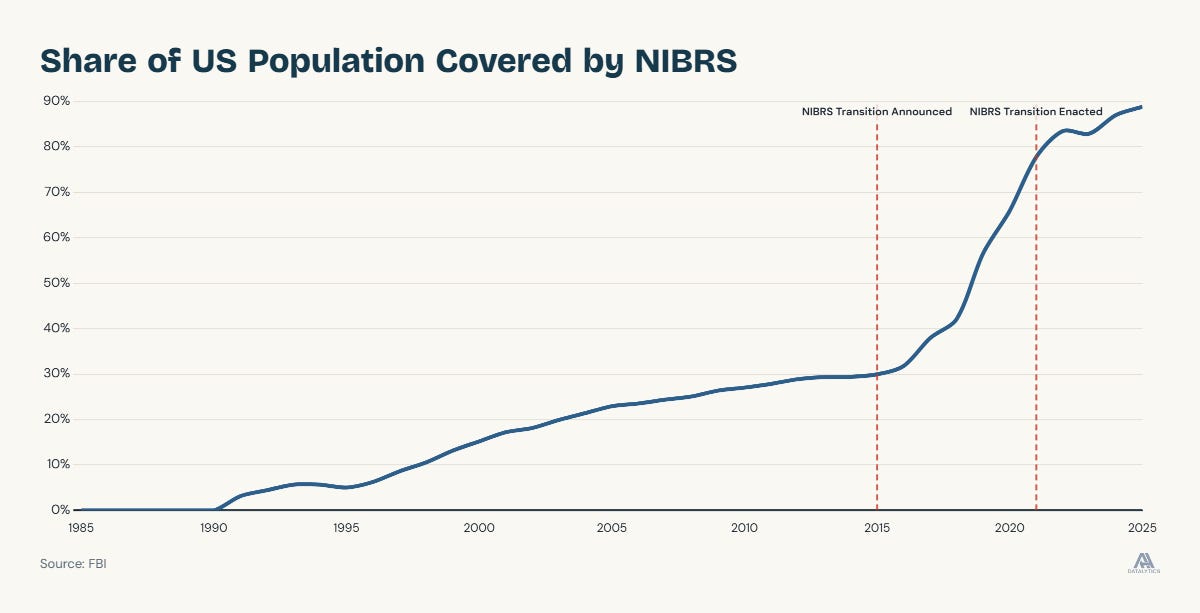
The NIBRS transition doesn’t just mean we’re now able to collect data on a wider swath of crimes than under the old Summary Reporting System. It also forced thousands of agencies and scores of states to modernize their crime data collection and reporting systems.
Now, thanks to the NIBRS transition, there are states reporting weekly and even daily data to the FBI rather than waiting until April of next year to report it. This isn’t quite baseball’s Statcast for crime but it’s an incredible advancement in just a few years.
The second major leap came from the FBI itself. In August of last year the FBI began publishing monthly data updates through its Crime Data Explorer. These updates are incomplete — in that not every agency reports each month — and they are unaudited. But if you understand the drawbacks in the monthly updates you can appreciate the incredible beauty in having all of this data suddenly available.
Now we have monthly crime counts from thousands of agencies nationwide. We also have the master files that make up every murder and every NIBRS incident that gets sent to the FBI. Yes, it’s underreported, but it’s underreported in predictable and auditable ways that enable smart conclusions to be drawn about our current crime and policing trends.
The result is that I can tell you now, in late September, roughly how many murders there will be in 2026. There’s a margin of error to it, but the days of waiting until September 2027 to get data from a January 2026 crime have long passed.
And there are clear ways for crime data to get even better. There are still agencies that are not NIBRS compliant or are not effectively reporting data to the FBI on a regular cadence. Some states do not send data regularly to the FBI, and more agencies reporting data faster will mean a fuller, faster understanding of our nation’s crime trends.
Our crime data still is not perfect, but that imperfection can be understood and overcome. Crime data is increasingly improving as more agencies report more complete data faster. We’ll probably never get anywhere close to a baseball-level of crime data, but the improvements over the last five years mean that the ‘what’ of national crime trends is now almost entirely solved.
The key question, therefore, is not what is happening in crime in the U.S., it’s why is it happening and what we can do about it.
New on the Jeff-alytics Podcast
Tune in tomorrow for a Tuesday podcast release. It’s a fun one!
Most efforts to reduce crime focus on who is committing it. Megan Grable’s work focuses on where.
She’s a neighborhood planner with the city of Fort Wayne, Indiana, and the unlikely champion of something called CPTED or Crime Prevention Through Environmental Design. CPTED is a field based around the idea that the built environment shapes behavior, and that better streetlights, smarter landscaping, and stronger social ties can meaningfully reduce crime.
Megan Grable is an Urban Planner with Fort Wayne’s Department of Neighborhoods, using data-driven strategies and deep community relationships to deliver transformative urban solutions. She leads the award-winning CPTED Pilot, revitalizes neighborhood associations, and applies global perspectives to advance evidence-based approaches that reshape how cities design for safety and impact.
Good work, Jeff. Thanks, in part, to your efforts, the attempted weaponization of Crime by (right-wing) politicians can now be factually debunked - at least for those who value facts.