

You may recall from last week’s podcast (Apple link here) that Malcolm Gladwell has a new book out called The American Way of Killing. A lot about the book stood out to me, but there was one story in particular that we talked about on the pod that is worth expanding on in this here newsletter.
Here’s Malcolm talking about the story on the pod as an intro:
Here’s what happened: in the book, Malcolm talks with Dr Eddie Cornwell, a trauma surgeon in Washington, DC who specializes in treating gunshot victims. Dr Cornwell tells the story of one gunshot victim that he operated on in 2004. The victim is a 25 year old man who was shot four times: in his right chest, left chest, thigh and scrotum.
Dr Cornwell describes him as “very close to death” with what he says is a 70 percent chance of dying. Yet, the patient lived, and recovers far quicker than Dr Cornwell ever would have guessed. His key question is ‘why?’
Dr Cornwell has seen scores of gunshot wounds to the chest and knee, but the gunshot wound to this victim’s scrotum was seemingly different. Urologists noted that near his entire testicles had been destroyed meaning the victim’s testosterone level had plummeted.
Is it possible that testosterone inhibits male gunshot survival? Gladwell cites Dr Cornwell saying “doesn’t it make sense that the female sex…would be more tolerant of hemorrhage, because the survival of the species depends on female fertility, which is defined by monthly hemorrhage, cyclical hemorrhage?”
I am not qualified to evaluate this question from a medical standpoint, but I figure I can look at whether there’s any crime data out there that might support or refute this question. I think that the answer to that is a definitive — maybe.
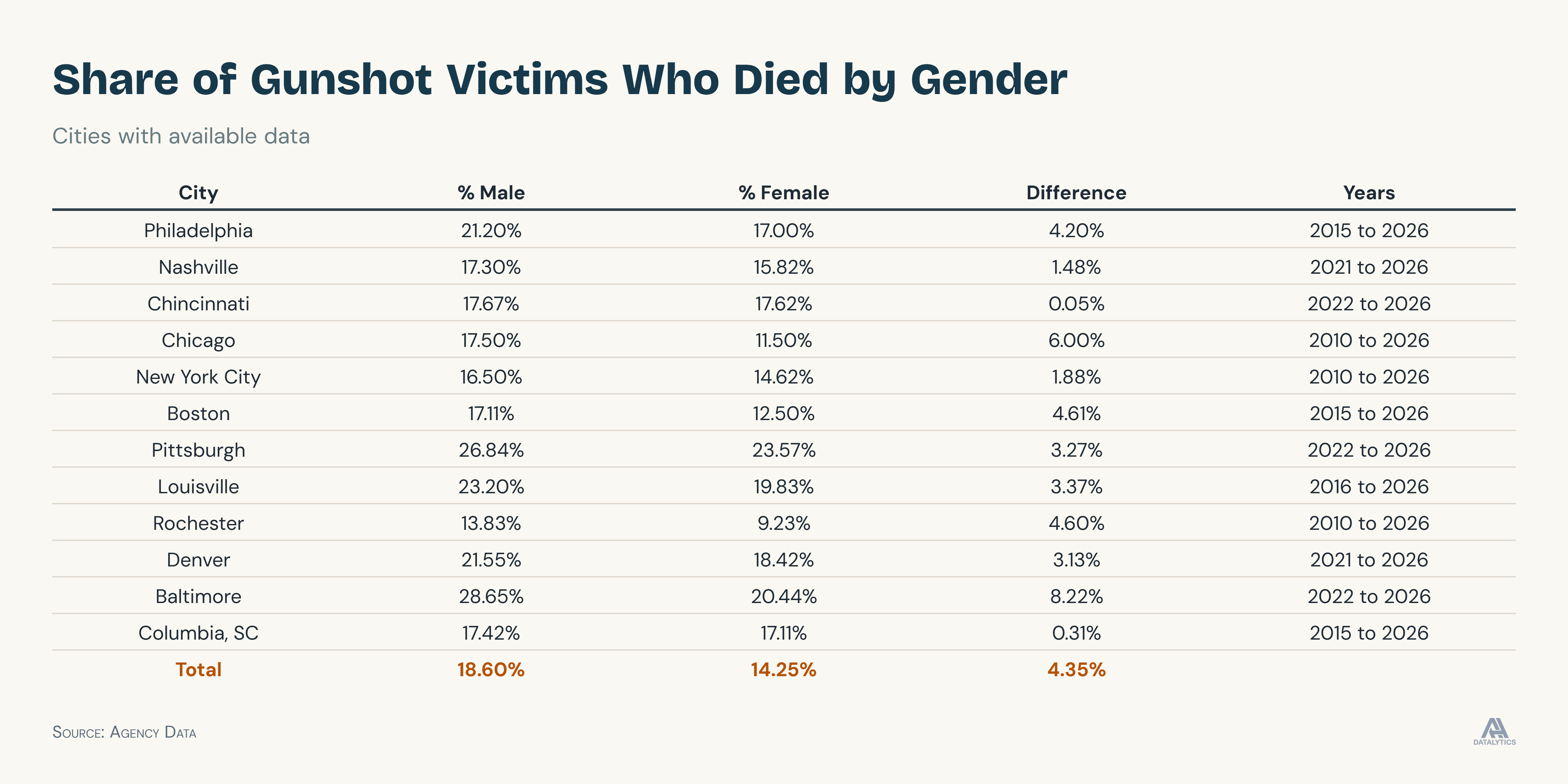
To dig deeper, I grabbed shooting victim data from a dozen cities that publish it. I went back to 2015 for the cities that had data going back that far, otherwise I started in the first year of available data.
It turns out that a higher share of men die in shootings than women in each of 12 cities over those spans. The difference was quite small in a few cities (Cincinnati and Columbia, SC), but overall men died at higher rates in shootings in every city, some by quite a large margin.
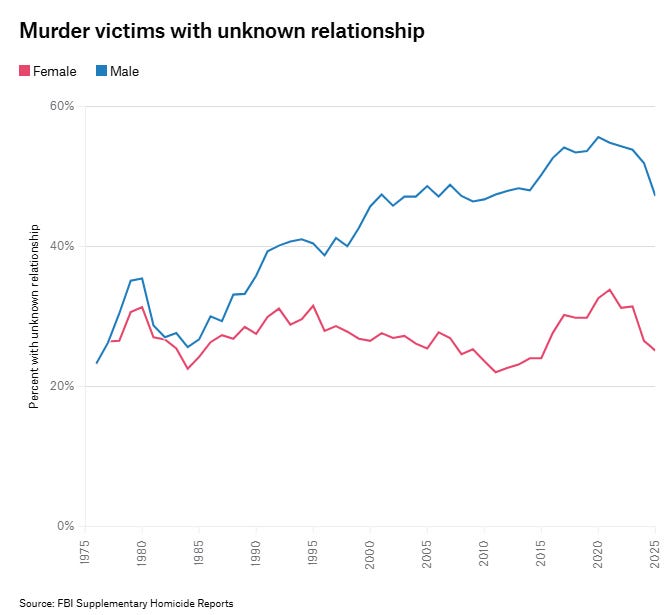
There are differences in male and female gunshot victimization that could explain this issue beyond just biology. I just so happen to have a recently published piece in Vital City that looks at trends in female homicides. In that piece, I find that female homicide victims are far more likely to know their attacker than male victims. This is driven in no small part by the fact that female homicide victims are substantially more likely to be killed in intimate partner violence than males.
Perhaps relatedly, the physical location of where women are shot may be different than men which could conceivably help explain differences in survival. Very few places publish tracked data on where bullets hit, but Philadelphia does!
I grabbed their data on more than 10,000 shooting victims since 2015 and it shows the potential differences in where each gender is shot. More than a third of shooting victims were shot in multiple parts of their body compared to less than a quarter of female victims. Women were, by contrast, more likely to be shot in their head or neck area.
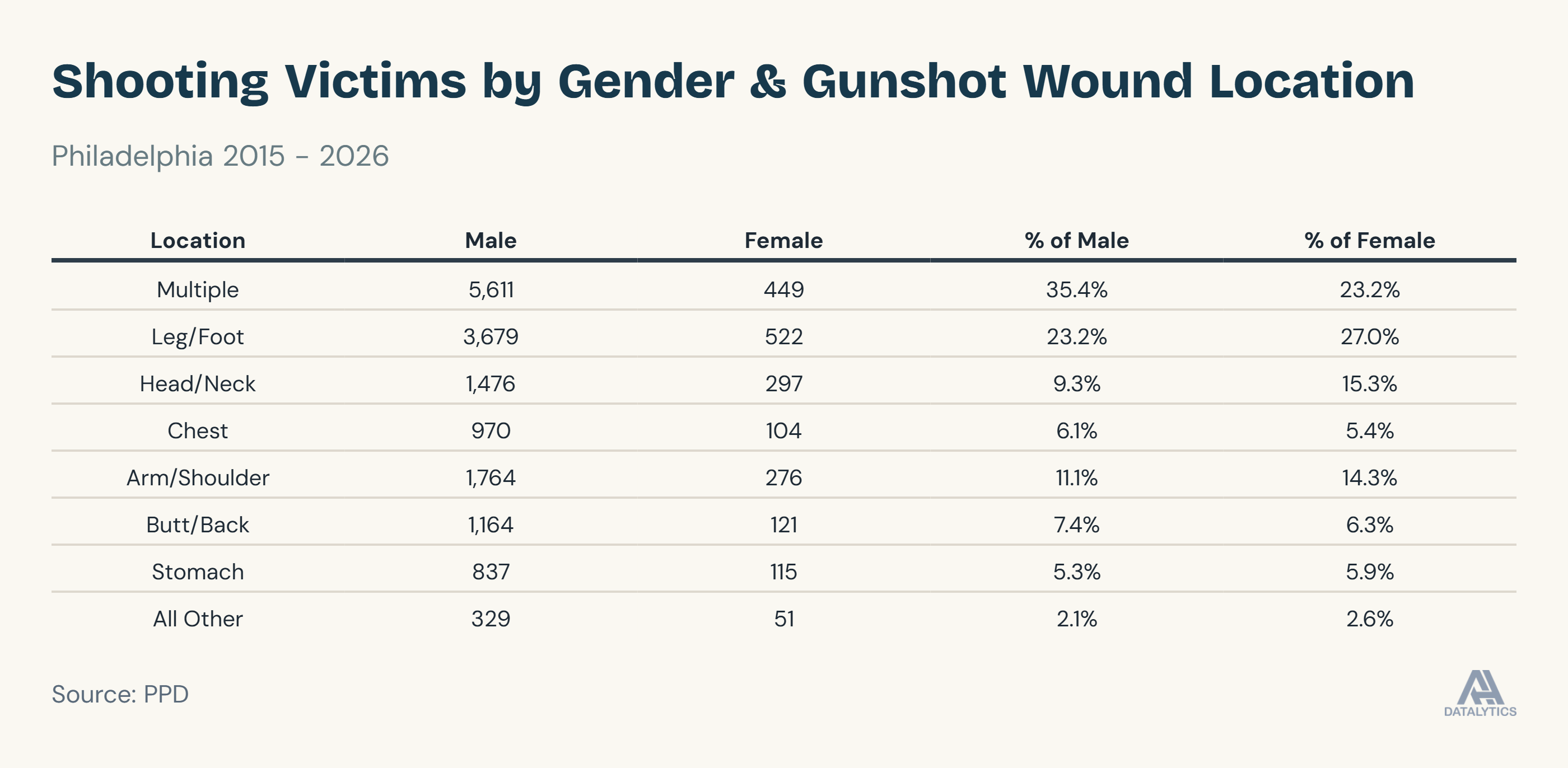
Again, not a doctor, but I would think that the number of times someone is shot and shootings around the head/neck and chest would be strongly determinant in a victim’s odds of survival. In the Philadelphia data, people with multiple gunshot wounds died 24 percent of the time compared to 13 percent of people without multiple wounds. Even then, however, the gap gender gap is nearly identical in Philadelphia regardless of whether victims were shot multiple times. Between 2015 and 2026, 20.7 percent of women with multiple gunshot wounds in Philadelphia died compared to 24.3 percent of men.
What does this all mean?
It could mean a lot, it could mean nothing. It obviously highlights just how poor our data collection and reporting systems are around gun violence. I was only able to find a dozen cities that publish victim-level data on a multi-billion dollar public health issue.
Maybe the difference in survival rates is because men are more likely to be shot multiple times for whatever reason. Without better data from more cities it’s really hard to draw strong conclusions.
It also presents possible areas of trauma care research though, again, not a doctor, I have no idea whether these findings would be novel, are currently well known, or laughed away by an actual doctor who specializes in the field. Still, from where I sit, it’s an interesting albeit not comprehensive case study with potentially life-saving implications.
New on the Jeff-alytics Podcast
There’s more Malcolm, the guest on the 50th episode of the Jeff-alytics podcast and it’s a terrific conversation). He has a new book out today titled The American Way Of Killing and he was kind enough to come on the show to talk about it.
The American Way Of Killing is an attempt to have an honest conversation about gun violence and what we’re missing because the conversation around it is so often disingenuous. In this episode, we get into why American doctors have gotten so good at treating gunshot wounds, the Second Amendment’s actual origins, and why work done in Boston thirty years ago should speak to us about how to reduce gun violence today.
This was a terrific, engaging conversation on what we know and don’t know about gun violence in the United States and I think you’ll like it!
Malcolm Gladwell is a journalist, a speaker, host of the hit podcast Revisionist History, and the author of several New York Times bestsellers including The Tipping Point, Outliers, David and Goliath, Talking to Strangers, and The Bomber Mafia. His forthcoming book, The American Way of Killing (out September 29, 2026), is an incisive investigation into gun violence, America’s deadliest and most polarizing crisis.
While the public Philly shooting data does not have victim/offender relationship, it does have whether the shooting happened indoors or outdoors. Shootings that happen indoors, according to my models in https://link.springer.com/article/10.1007/s12061-020-09362-3, increase your odds of death by around 50%.
But yes location of the injury (head in particular) is the highest risk factor. (Wish I could share images in comments!)
Whether or not "testosterone inhibits male gunshot survival" is an open question. However, testosterone is a Yoooge factor in the shootings that do occur since boyz are responsible for 85% of US gun violence.