
Does Entropy Explain Why Crime Is Dropping?

Crime in the United States has been dropping steadily since the latter half of 2022, and one of the main challenges of explaining it is that the drop defies most simple explanations. The latest Crime Index update puts murder down around 18 percent through May 2026 in a sample of more than 580 agencies covering more than 122 million people nationwide.
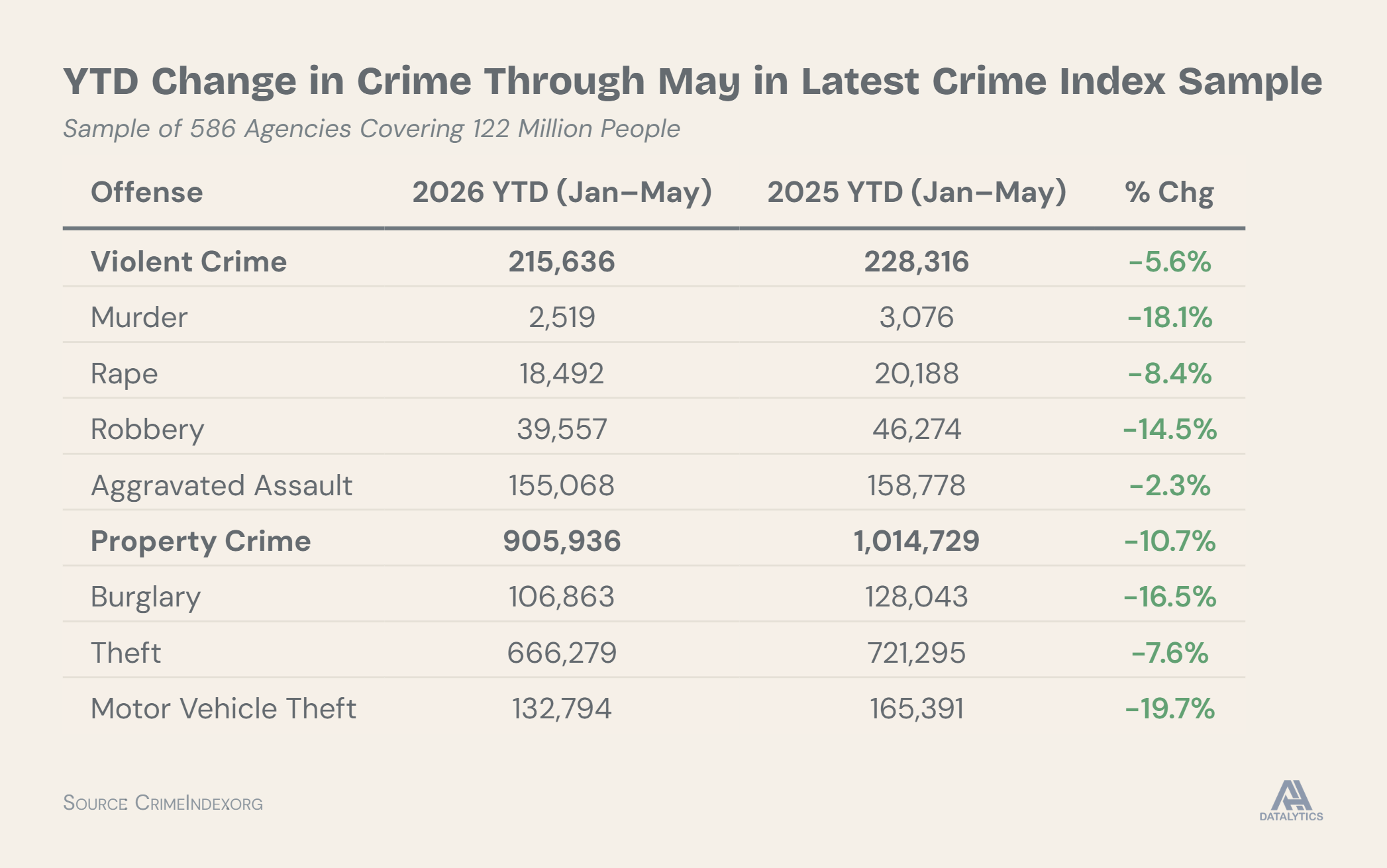
The crime drop is happening pretty much everywhere, so that great neighborhood program your city launched a few years back — while great — probably doesn’t explain a ton of why crime is declining. It happened a time of declining police staffing, so it’s not like the 1990s when a lot of agencies hired a ton of new officers and subsequently saw large drops in crime (OVERSIMPLIFICATION ALERT!).
It started falling in 2023 under the Biden Administration and has continued and possibly even accelerated under the Trump Administration, so there’s no easy and obvious political credit to be had in my opinion. It has happened in places with “tough on crime” prosecutors and in places with “progressive” prosecutors. It has happened in red states, blue states, and purple states.
I have argued that there’s evidence that spending a ton of money post-COVID on a number of programs — some tied to crime reduction and most not — likely played an intricate role, but a lot of the post-COVID social programs and other spending has wound down or been eliminated, and yet murder keeps falling month after month after month. You can point to more proactive policing over the last few years as a potential driver of lower crime, but the evidence of that is not super strong — at least not yet.
That’s why I was so intrigued by a recent paper from Scott Mourtgos and Ian Adams that argues one word may be a major contributor to falling crime in America: entropy.
Now, this paper is a pre-print and isn’t peer reviewed, but their conclusion is very interesting.
What is entropy? I’m glad you asked. The Miriam-Webster dictionary defines ‘entropy’ broadly as “the degree of disorder or uncertainty in a system.” I like to think of it, probably oversimplifying again, as society is improving.
They write “We argue that national crime trends reflect changes in criminogenic entropy: the number of feasible crime-producing configurations in a society.” In other words, national crime trends over the last few decades generally reflect big overarching factors in American society that got worse in the 70s, 80s and 90s and have been getting better ever since. Entropy helps explain why pinpointing what is driving crime trends is so difficult.
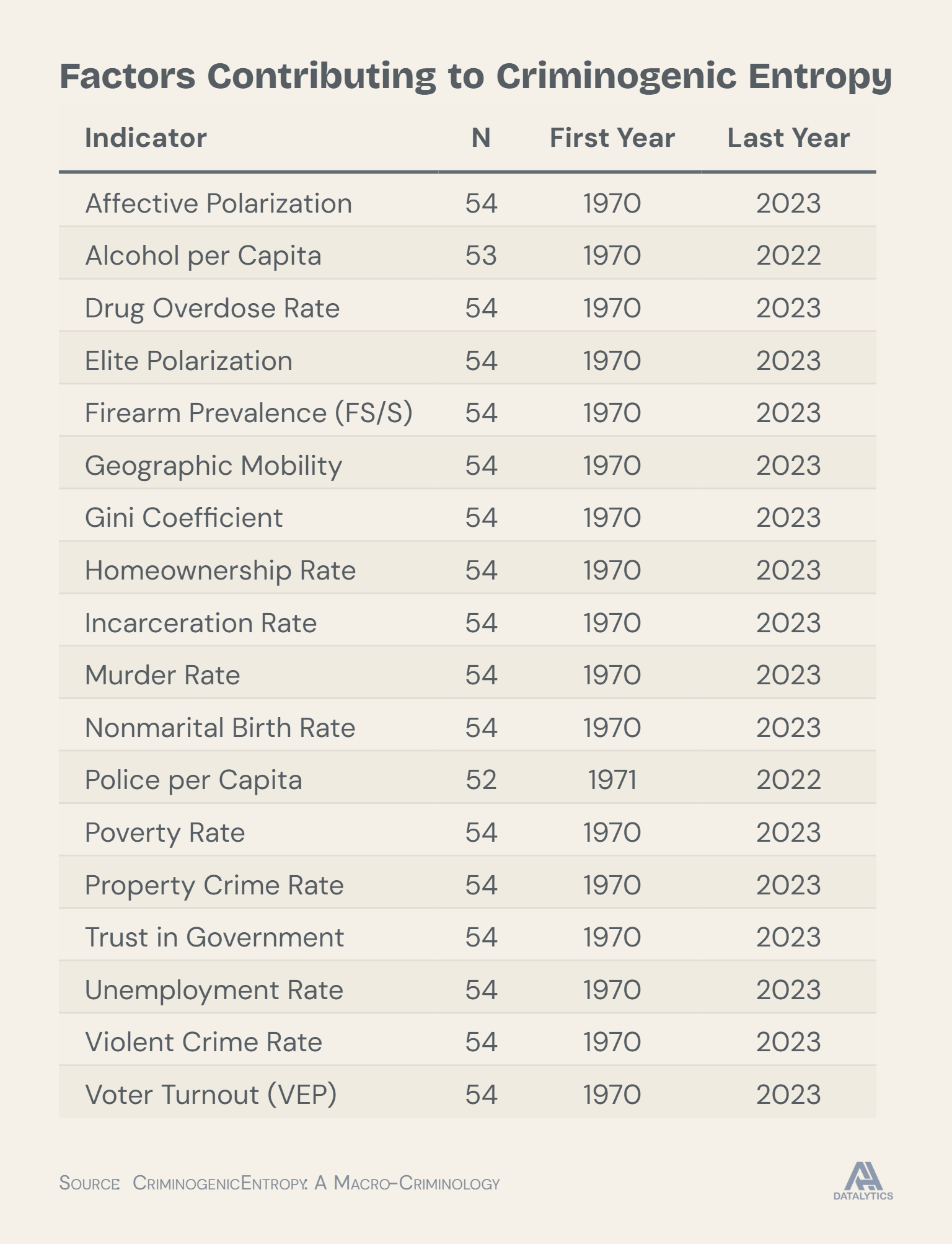
Adams and Mourtgos identify 15 measurable factors that contribute to this “criminogenic entropy”, some of which like substance abuse and inequality contribute to more crime and others like homeownership and institutional trust contribute to less crime. Taken together, these factors peak “in the 1980s–90s and declines thereafter, closely tracking violent crime and property crime.” I’ve reproduced the full list of factors (handy link here) below. You can play around with these factors in a handy and fun dashboard that Mourtgos built if you’re so inclined.
But, wait, you might say, murder spiked enormously in 2020 and has been falling at a historic clip ever since. Well, Adams and Mourtgos argue that “entropy continues declining through 2020–2021 despite a sharp murder increase, indicating an exogenous shock to an otherwise compressing system.” So the spike in 2020 and 2021 was a one-time shock to the system that has been followed by a return to the pre-existing entropic trendline once the shock had dissipated.
Another section that stands out to me is later in the paper when they note that “entropy moves on a generational scale; barely shifting from one year to the next, consistent with a structural quantity rather than a short-run fluctuation. Year-to-year innovations were small…meaning that shocks contributed modestly relative to the accumulated structural state. Entropy, in other words, remembers where it has been.”
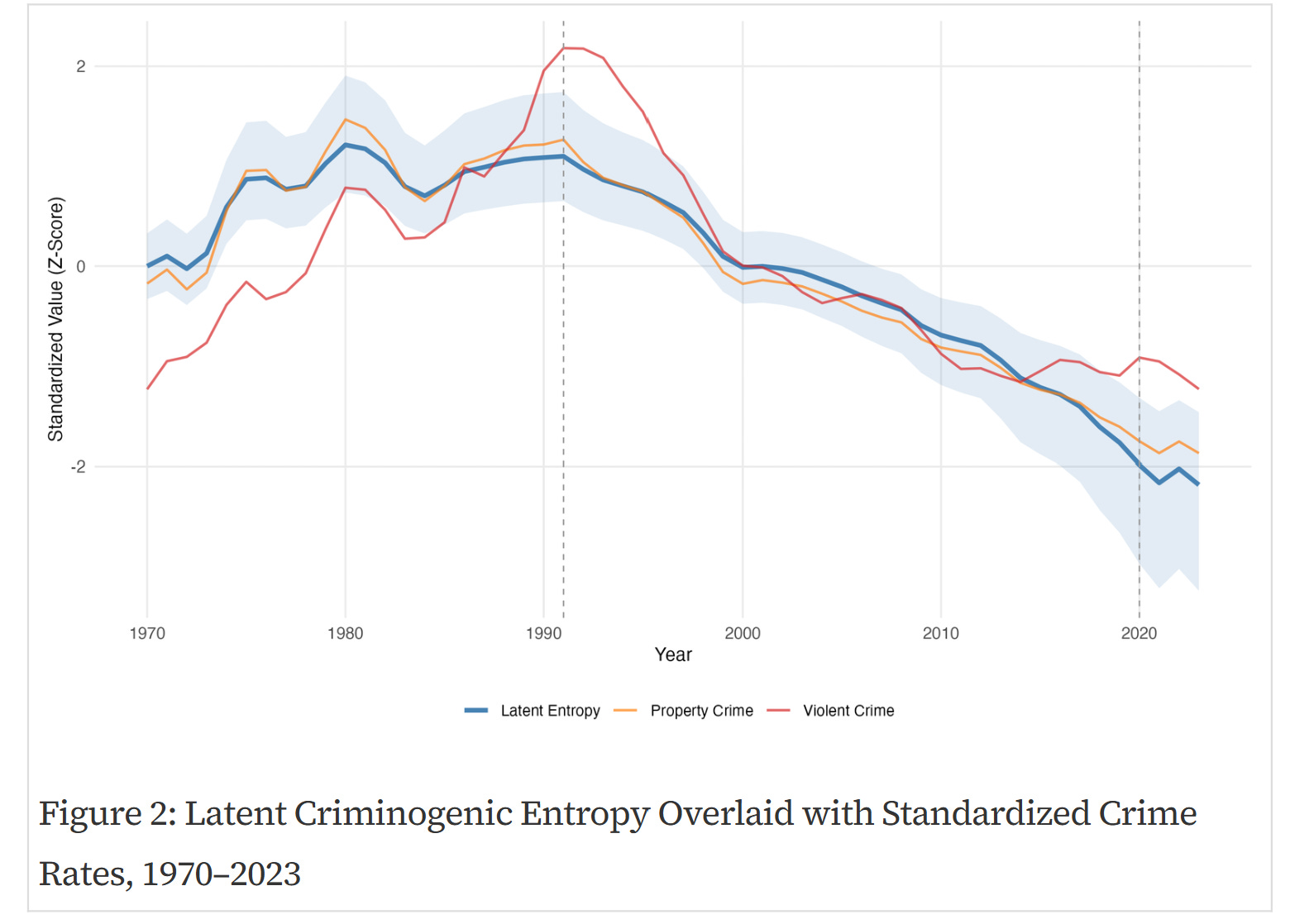
All of this helps explain this decade of murder in the United States. There was an external shock (or several external shocks) that produced years with an enormous increase in murder from the previous baseline. You could say the same about 2015 and 2016 — albeit to a lesser extent — as well. But then the trend returned to what it was going to be beforehand.
Entropy also helps explain the broadness of the decline in my mind. No, that one program your local police department or city is running is probably not directly causing the drop in crime you’re seeing right now, but (at least in my mind) the societal improvements across hundreds or thousands of new programs and neighborhood centers together contribute to the broader downward push.
The return to the pre-COVID long term trend could be a reflection of criminogenic entropy, but that doesn’t mean that violence would have fallen so dramatically without the new programs, investments, and hard work done by untold people to reduce violence. In my mind at least, it was all that work that created the conditions for the historic drop in violence that we have seen in the last 3.5 years — even if entropy suggests a drop to some unknown degree would have occurred at some point.
The study’s data ends in 2023, but forecasts for 2024 match what we know happened that year (a large drop).
Overall, I found the idea to be an interesting addition to the “why is crime falling” discussion. Obviously there’s a long way to go before we collectively have a comprehensive theory of why murder rose so much in 2020, why it started falling so significantly in 2023, and why it has continued to drop for the last 4 and a half years. It’s also plausible that had you chosen 15 other factors as your criminogenic entropy that you might get a whole different answer altogether.
Entropy may not be the answer (or the only answer), but I found this paper to certainly be compelling that it may be an answer to the critical question of why crime is falling. And if we can answer that question more definitively then we can do more to keep this historic drop in crime going.
New on the Podcast
Andy Wheeler, a renowned criminologist, data scientist, and founder of Crime Decoder. Andy is a terrific voice for explaining the role technology can play in analyzing and decreasing crime as well as the barriers to adopting new techniques and technologies.
This is a great conversation about how the future of criminal justice analysis is already here.
Andrew P. Wheeler, PhD and founder of CRIME De-Coder, collaborates with police departments across the United States on custom software and data analytics. His work focuses on predictive analytics, operations research, and policy analysis. See his firm and other resources at https://crimede-coder.com/.
Andy also has a recent book, *Large Language Models for Mortals: A Practical Guide for Analysts with Python*, https://crimede-coder.com/blogposts/2026/LLMsForMortals
You can also catch it on the Jeff-alytics YouTube page where I’ll be posting episodes and video clips, so be sure to like and subscribe there if you’re so inclined!
And while you’re here, be sure to check out these other recent great episodes:
Filmmaker Lynn Novick
Georgetown Professor Christy Lopez
Yale School of Public Health Dr. Megan Ranney
Fund for a Safer Future CEO Rob Wilcox
All the criminals have been hired by ICE. Guaranteed income, no chance of jail or even fines. What a deal.
Where does the “lead toxicity” hypothesis (of which I am a strong believer) fit into this model of explanation?