
Appreciating Just How Far Murder Has Fallen in the US

I talk about US murder trends a ton which usually involves a lot of numbers. Oftentimes, focusing on the numbers means losing sight of just how much progress has been made over the last 35 years. But sometimes the scale of the decline from the peak number of murders to today gets lost on you. I was posting my monthly thoughts on crime on May 1st over on Bluesky I was struck by the magnitude of the decline in so many cities.
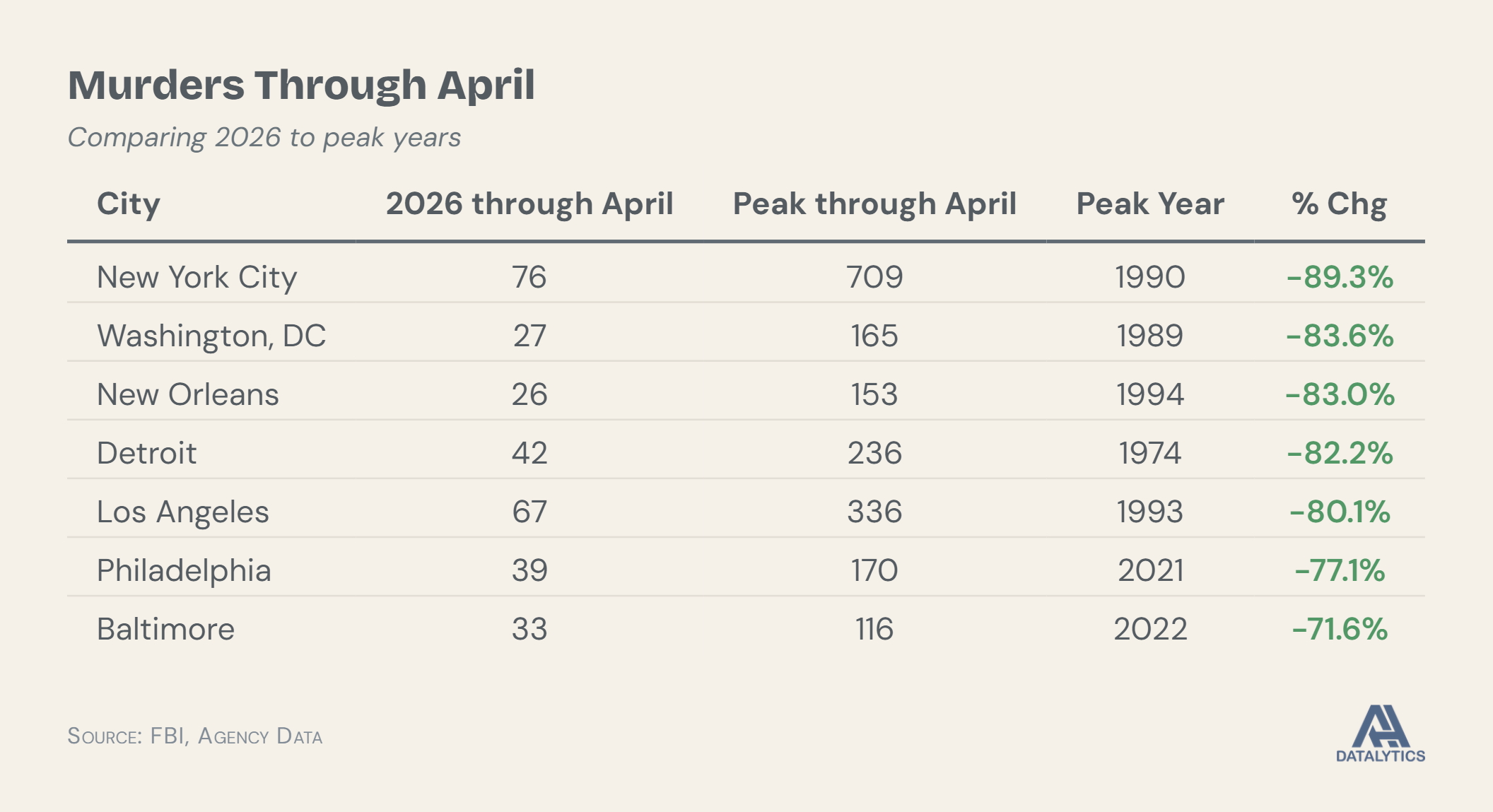
New York City reported 76 murders in April 2026, down considerably from last year when the city reported 102 murders through April. But then you chart New York City over the last 65 years and the scale of just how awful the 1990s were there comes into plain view. There were an astounding 709 murders in the first four months of 1991, meaning April 2026 was down nearly 90 percent by comparison!
New York City isn’t alone. Philadelphia, Detroit, New Orleans, Baltimore, Washington DC, and Los Angeles all have seen unbelievably large drops to near historic levels in 2025 and 2026.
And here is the murder rate for each city for those of you who need it.
These cities aren’t the only cities with huge declines, but they’re the ones that stand out the most in the available data. Murder in NYC is down nearly 90 percent relative to where it was through April 1990, it’s down more than 80 percent in Washington, DC, New Orleans, Detroit, and Los Angeles compared to the peak murder year in those cities, and down more than 70 percent in Philadelphia and Baltimore.
Nationally, there were about 8,000 fewer murders last year than each year from 2020-2022 and about 10,000 fewer murders than there were in the early 1990s. That works out to a national murder rate that was less than half of its peak in the 1980s and 1990s.
Sometimes these posts present fresh data on new trends while other times they offer deep analysis of ongoing issues. This post, by contrast, hopefully serves to appreciate just how far murder has fallen in so many places. These problems aren’t solved by any means, and there are still far too many tragedies in these cities and nationwide. But sometimes it’s worth appreciating how much better things are now than they were 50, 30 and even 5 years ago when considering where we are today.
New on the Jeff-alytics Podcast
Sometimes the hardest part about a crime isn’t figuring out what happened — it’s revisiting what’s already been decided. Once a case is closed and a conclusion settles in, changing that can be just as difficult as investigating it was in the first place.
My latest guest is Jill Collin Jefferson, a civil and human rights attorney and the founder of JULIAN, an organization focused on investigating modern-day lynchings. JULIAN works with families and communities seeking answers in cases that have often gone unresolved or unquestioned.
And while you’re here, be sure to check out these other recent great episodes:
Law professor Rachel Harmon
Reporter Ken Dilanian
New Orleans Mayor Helena Moreno
Researcher and Former Crime Analyst Carlee Ruiz
Thanks for the articel. We witness something historical and not enough people are talking about it.
Thanks for the reminder, and the charts!
My takeaways are: (1) The murder rate is way down - great progress is being made. And also, (2) in many cities, there is still a lot of work to do.
For example, Washington DC is much safer than it was in the bad old days of the 1990s, when 400+ murders a year was the norm. That is worth celebrating! But the murder rate (and the rate of violence generally) is still much too high for complacency. Boston wasn’t included in these charts, but I think it’s an interesting comparison. About the same population as DC, increasingly ethnically diverse, and with a large gap between rich and poor. Boston reported 31 murders last year while DC reported 187. I don’t know what accounts for the difference, but it’s dramatic, and it’s a real-world benchmark; I’m not comparing DC to perfection or a pure thought exercise. (Last year’s Boston number actually reflects an uptick - there were 24 murders in 2024, so that’s an even more ambitious goal….)
I’m sure you have a lot of projects lined up and plenty to do, but if you ever get interested in why Boston does so well and which of its strategies can be replicated by other cities, I’d love to read about it.